


Other Resources
ALL ARTICLES


Help Center


Below you will find a number of topics ranging from personal to business banking.

Our ultimate goal with our MSB community is to be a resourceful partner in compliance. We want to see you succeed and see your customers succeed. In this article we’ll cover the very important topic of passing a state exam or an audit. We want to help you understand how to approach it and steps you can take to be successful.
Be Organized
This may seem at first like the simplest approach, but we see MSBs everyday who don’t have their business and paperwork in order. They don’t have foundational systems in which they run their business and it shows in their disorganization. Most of the time not having a formal process that your team can work from begins to disrupt all kinds of other aspects of your business.
Making the choice to get organized is of high value when it comes to passing any state exam or audit. Knowing you can put your hands on any documents that are requested is a good feeling and excellent way to know what is happening at any time in your business. Scrambling last minute to find information usually results in undue stress on you and your team and inevitably creates bigger problems as one event leads to another.
Be Aware of What’s Required
The great part of any state exam or audit is that it is not a mystery. Everything that is required of you is available online. If you want to build a process around a successful exam, take a look at the appropriate resources and prepare accordingly.
Below is the link to the FinCEN MSB Exam manual. This is what FinCEN uses when conducting an exam on a MSB. Studying this document is like getting a copy of the test before you take it.
https://www.fincen.gov/sites/default/files/shared/MSB_Exam_Manual.pdf
There are all the resources you need to comply with the agency who will be examining your business. The bottomline is that you and your team just have to do the front end work of studying them so you can organize your process around them.
Be Respectful
Having helped many MSBs for many years, we’ve seen the potential for some of them to not respect the position or authority of the examiner and the role they play in keeping the industry regulated. As an MSB, it is important for you to do your part in complying with the regulators.
Regulators are just normal people that put on their pants on one leg at a time, just like we do. So treating them with respect and not having a confrontational relationship with them typically leads to them not making you have a bad day. This is very similar to your interaction with a police officer. When you get pulled over, it’s better to just cooperate with their requests (license, registration etc) rather than being disrespectful.
In summary, our best advice is to do the right thing every day. Then it’s not going to feel like you’ve got two years worth of weight on your shoulders trying to get ready for an exam.
If you would like more information on this topic or any topic that is related to running a successfully compliant business, reach out to our BSA team at www.mysuretybank.com/msb.


It’s November, your store is packed, the line at the register is snaking down the aisle and your seasonal staff is doing their best to keep up. You’re watching every sale, every return and every refund, knowing that the next six weeks can make or break your year. With card processing fees climbing, it’s tempting to push customers toward cash and even add a 3% “convenience” or “non-cash adjustment” fee when they tap or swipe a card. After all, there are no fees on cash… right?
The problem is that cash comes with its own price tag, one most retailers don’t see until it’s quietly eaten into their margins.
A study by the Small Business & Entrepreneurship Council found that the real cost of cash can range from 4.7% (grocery) to as high as 15.5% (bars and restaurants) once you factor in labor, handling and shrinkage. That means for every $100 in cash you accept, you might really be keeping only $84.50 to $95.30.
For many retailers, the biggest hidden cost is time:
For example, convenience stores—which operate in a similar high-volume, low-margin environment as many retailers—spend an estimated 15–20 hours per week just counting and handling cash. At an average wage of $14.33 per hour, that’s:
Over a year, that works out to $11,177–$14,903 in labor just to handle cash. During the holidays, when lines are longer and staff is stretched thinner, those hours often go up, not down.
Cash also keeps you in the dark longer than you might realize. With cash-heavy operations, you often don’t know your true daily performance until drawers are counted, deposits are prepared and everything is reconciled—sometimes hours after the store closes. That lag makes it harder to adjust staffing, reorder inventory or tweak promotions while it still matters.
Electronic payments, by contrast, can feed real-time metrics into your point-of-sale and treasury platforms. You can see, often down to the hour, what’s selling, which locations are busiest, which promotions are working and how your cash flow looks heading into the next day. That visibility is especially valuable in the holiday rush, when a fast decision about staffing or inventory can mean the difference between a record weekend and missed opportunities.
On top of labor, cash exposes retailers to risks that electronic payments help reduce:
This is why many banks are rolling out treasury platforms with fraud controls, positive pay, ACH options and remote deposit capture to help business customers move away from “cash management” and toward cash flow management. Framing the conversation around speed, security, real-time information and time savings can be more effective—and more honest—than simply pushing for “more cash.”
Let’s apply real numbers to a typical retail scenario.
Say you own a store and decide to add a 3% convenience fee to card transactions while still accepting cash. Here’s what happens on a $100 ticket:
Card payment with a 3% convenience fee
Cash payment with hidden costs (using the 15.5% example)
So for every $100 transaction, you effectively keep:
That’s a $15.41 difference per $100 ticket in favor of electronic payments.
During the holidays, when your volume spikes, that gap adds up quickly. The season you’ve been counting on to boost profits can quietly turn into the season where hidden cash costs quietly steal them away, one transaction at a time.
If you’d like to talk through how to reduce the hidden costs of cash, improve fraud protection and gain better real-time visibility into your business accounts and merchant processing, contact Surety’s Treasury Services Department to discuss business accounts and merchant accounts with built-in protection.

As more banking moves online, security has become just as important as convenience. Whether you’re checking a personal account or managing company finances, your computer habits play a critical role in keeping your information safe. A few consistent practices can greatly reduce your risk of fraud and protect sensitive data.
Malware can capture keystrokes, steal login credentials, and access personal files without you realizing it. To stay protected:
Make full use of the security tools your devices and bank provide:
Closing your browser window isn’t enough to end your session.
Browsers can store sensitive information like login pages or cached credentials. To protect yourself:
Phishing emails and fraudulent pop-ups can trick you into giving away banking information. Watch for:
Best practice: Always access your bank by typing the official web address directly into your browser, never through email or ad links.
Businesses face higher risks, so proactive steps are essential:
Online banking can be safe and reliable when paired with good cybersecurity habits. By:
…you can protect both your finances and your peace of mind.
The key is consistency. Security isn’t a one-time task—it’s a set of habits built into your everyday banking routine. Taking these steps ensures your accounts remain secure, your sensitive information stays private, and you can manage your finances confidently, whether personally or for your business.

Cash flow is the lifeblood of any business. Whether you're managing a commercial construction firm or running a retail operation, understanding how money moves in and out of your business is key to long-term success. Poor cash flow management can leave businesses scrambling to cover expenses, even when profits look good on paper.
A recent episode of the Expandable Series discussed this in detail, but here are some fundamental cash flow principles, using commercial construction as an example, that apply to businesses across all industries.
1. Understand Your Cash Outflows
In commercial construction, significant cash outlays are required upfront for raw materials, permits, and labor. These costs must be covered well before payments from clients arrive. Similarly, in retail, manufacturers need to purchase inventory long before customers make a purchase.
A business must have enough cash on hand to cover these expenses. Without it, operations may stall, delaying projects and impacting profitability. Understanding your cash needs ahead of time ensures smoother financial management.
Example: Imagine a mid-sized construction firm, Apex Builders, takes on a new commercial office project. Before the first payment arrives, they must pay for steel beams, concrete, and skilled labor. Without proper cash reserves or a well-structured payment schedule, Apex Builders could struggle to cover these costs, potentially halting the project and damaging their reputation.
2. Time Your Cash Inflows Strategically
Revenue in commercial construction typically comes from milestone payments throughout a project or upon completion. However, these payments can be delayed due to contract terms, client approvals, or unexpected issues.
For any business, it’s essential to analyze how long it takes to convert expenses into revenue. Are you waiting 30, 60, or even 90 days to get paid? If so, your business must be structured to withstand these gaps. Ensuring that your contract terms align with your cash flow needs can prevent unnecessary financial strain.
Example: Apex Builders structures their contracts to ensure payments are received at key milestones—such as after the foundation is laid, after framing is completed, and upon final inspection. By planning these payment intervals, they reduce financial stress and ensure they always have working capital.
3. Build a Cash Buffer
One of the best strategies for managing cash flow is to build a buffer that accounts for timing discrepancies. In construction, this means having enough reserves to cover payroll and material costs while waiting for payments. The same principle applies to any business with delayed payments.
This buffer should be built into your pricing. Instead of operating on razor-thin margins, factor in potential delays and unexpected costs when setting your rates. This ensures financial stability even during slower payment periods.
Example: Apex Builders includes a 10% contingency in their project bids, ensuring that if a client delays payment or unexpected costs arise, they have the liquidity to keep operations running smoothly.
4. Plan for Payroll and Fixed Expenses
Payroll is a non-negotiable expense in any business. Employees expect timely paychecks, and failure to meet payroll obligations can lead to operational disruptions and even legal consequences.
Since payroll and other fixed expenses (like rent, utilities, and insurance) don’t change based on revenue fluctuations, they must be accounted for in advance. Forecasting these expenses over the next quarter will help ensure you always have the necessary funds available.
Example: Apex Builders schedules payments from previous projects to help cover payroll during slow months, ensuring that employees are always paid on time.
5. Look Ahead to the Next Quarter
Successful businesses don’t just think about today’s cash flow—they plan for the next quarter and beyond. What projects are in the pipeline? When will revenue from those projects be realized? What expenses need to be covered in the meantime?
By forecasting cash flow and preparing for potential shortfalls, businesses can make informed decisions about when to invest, when to hold back, and when to seek additional financing options to bridge any gaps.
Example: Apex Builders maintain a rolling cash flow projection, helping them anticipate slow periods and ensuring they never take on more projects than they can financially support at one time.
The Bottom Line
Cash flow management isn’t just about tracking numbers—it’s about planning ahead, building flexibility into your pricing, and ensuring your business can withstand the natural ebbs and flows of financial cycles. Whether you’re in commercial construction, retail, or any other industry, mastering cash flow is essential for long-term success. Surety Bank is here to help businesses navigate these challenges with financial solutions designed to keep operations running smoothly.

Forget Growth for Growth’s Sake. Scale Your Company With Purpose!
Every business owner dreams of growth—the big contracts, the expanding team, the larger facility. Growth is exciting, but what happens when it outpaces your ability to sustain it? For small to mid-sized business owners, the challenge isn’t just getting bigger—it’s growing profitably. Scale too quickly, and you could find yourself losing control of your business. Scale too cautiously, and you risk stagnation. So, how do you strike the right balance?
The Growth Trap: A Cautionary Tale
Imagine you own a manufacturing company, and a massive order comes in. It’s a dream deal—10,000 units instead of the usual 1,000. You scramble to increase production, hiring new employees, ordering more materials, even taking on debt to finance the expansion. But a few months later, you realize you’re barely breaking even. The new employees aren’t fully trained yet, production costs have skyrocketed, and cash flow is tight. Your profit margins, which seemed healthy before, are now razor-thin. Worse, your suppliers have increased their prices due to the larger volume, but you didn’t adjust your pricing in time. You’re now operating at a loss, despite the influx of new business.
This scenario is all too common. Growth, if not managed wisely, can erode profits instead of increasing them. The key? Strategic scaling.
Profitability First, Expansion Second
In the early days, you might not be profitable, and that’s okay. Many businesses start in the red, investing in marketing, product development, and hiring. However, you must ensure you’re not losing money per product. If each unit costs $12 to make and you sell it for $10, no amount of scaling will save you—you’re just multiplying losses.
Similarly, new employees take time to become profitable. Hiring is an investment in growth, but it often takes months before an employee generates more revenue than they cost. Business owners must anticipate this ramp-up period and avoid over-hiring too soon.
Where to Focus Your Growth
Not all growth is created equal. The most efficient areas of expansion are those where costs scale more slowly than revenue. Prioritize these strategies:
Controlled Growth vs. Losing Control
Growth is exhilarating, but it must be controlled. Many business owners get so caught up in expansion that they give up too much equity, bringing in investors who eventually take control. Others overextend, running out of cash when things don’t go as planned.
Instead, keep growth sustainable:
Avoid Growth for Growth’s Sake
It’s easy to get caught up in vanity metrics—chasing higher sales, expanding into new markets, or acquiring more customers—without asking whether that growth actually benefits the business. But growth is not a goal in itself; it should be a means to an end. Every expansion initiative should answer a fundamental question: Will this make my business stronger in the long run? If the answer isn’t clear, it may be a sign to reassess.
Strategic growth means planning ahead. Before you leap, have a roadmap. Set clear, measurable goals, such as: “We aim to increase production by 50% over the next 18 months, which should yield a 20% revenue increase while maintaining a 15% profit margin.” This approach ensures that growth aligns with financial health, rather than just inflating top-line revenue while squeezing profits.
Smart business owners don’t just chase expansion; they balance growth with profitability. They scale strategically, ensuring each step forward is sustainable, and never lose sight of their core business strengths. With a steady hand, you can grow your company without losing control of it—and that’s the real measure of success.

At first glance, a checking account is a checking account. Money comes in, money goes out, and you check the balance when you need to. But the day you start running a business, the rules change, because the risk changes. Business accounts aren’t just “bigger” consumer accounts. They typically handle more transactions, more users, more payment types, and more moving parts.
There’s another key difference many owners don’t realize until it’s too late: business accounts generally do not have the same level of consumer protections that consumer (personal) accounts do. When something goes wrong, the process, timelines, and potential liability can look very different. That’s why fraud prevention for businesses isn’t optional. It’s operational.
Consumer (personal) accounts are usually simpler:
Business accounts are different by design:
And because business accounts are treated differently than consumer accounts, the responsibility to monitor activity and catch issues early often rests more heavily on the business.
Most business owners are busy. Delegating bookkeeping is smart, because your time is valuable. But delegation without visibility is where risk grows, especially when one person has end-to-end control.
Internal fraud often looks like:
It’s rarely dramatic at the beginning. It’s usually quiet, incremental, and designed not to be noticed.
Consider Lisa, who owns a growing medical practice. She hired a bookkeeper to “handle the finances” and assumed monthly reports were enough. Lisa rarely reviewed actual transactions unless something felt off.
Over time, the bookkeeper began issuing checks to a vendor that sounded legitimate. The amounts were small—$180 here, $250 there—coded as routine office supplies. The practice was busy, revenue was strong, and nothing looked “wrong” at a high level.
Six months later, Lisa’s accountant flagged unusual expense patterns during a quarterly review. By then, the total loss wasn’t a rounding error. It was meaningful, and the cleanup took time, created stress, and required uncomfortable conversations. The hardest part wasn’t just the money; it was realizing the problem could have been caught early with simple, consistent oversight.
You don’t need to become your own bookkeeper. You just need a rhythm of review that helps you spot unusual activity quickly, especially because business accounts don’t always come with the same consumer-style protections.
Try these straightforward habits:
Strong habits matter, but systems are what help you scale safely. Depending on your business, ask about tools such as:
Surety Bank can help you evaluate which controls fit your operation, set permissions correctly, and implement tools like Positive Pay in a way that’s practical—not burdensome. The goal is to put guardrails in place that make fraud harder to commit and easier to catch, without slowing down your business.
Residential accounts are often simpler and tend to come with broader consumer-style protections. Business accounts operate differently—more volume, more access, more complexity, and often less built-in protection. That’s why vigilance isn’t just a best practice; it’s part of responsible business ownership.
Fraud prevention isn’t about paranoia. It’s about professionalism: review regularly, limit access wisely, and build systems that protect your business long before problems appear.

In the heart of downtown, amidst the vibrant pulse of local eateries and community events, there’s a name that keeps coming up: Chef Nora. If you’ve dined at De La Vega, you’ve likely experienced her artistry on a plate. But beyond the signature flavors and culinary finesse, there's a deeper, richer story — one of family, perseverance, and community love. And now, with her latest venture, Golden Meals, Chef Nora is cooking up something even more personal.
Chef Nora’s journey into the restaurant world began two decades ago when she and her family — her parents, brother, and sister — moved from New Mexico to Florida. They left behind everything familiar on the word of a family friend who saw promise in a vacant restaurant spot downtown.
With only a bit of restaurant experience between them, they leapt into entrepreneurship. “It wasn’t just a job,” Nora recalls. “I had already worked in restaurants. I realized what I really wanted was to have my own.” The family rallied around her dream — a move that not only shaped their livelihoods but also laid the groundwork for something bigger than any one of them could have imagined.
Their first venture was De La Vega — a name that not only carried their family heritage but symbolized their growing identity in the community. “We started with Tex-Mex,” Nora explained, “but quickly realized there were too many of those already. So we pivoted to something unique: Latin fusion with a tapas concept.”
It was a family effort from the start. Nora spearheaded the menu, crafting recipes with creativity and care, while her brother took on the general manager role. “It was our school,” she says. “Everything we’ve learned in the past 20 years, we learned by doing.”
Today, De La Vega is more than a restaurant — it’s a beloved local fixture. With loyal customers, an ever-evolving menu, and a consistent focus on flavor, it’s the kind of place that gets recommended again and again.
The concept for Golden Meals was born not in a commercial kitchen, but in Nora’s own home. “My dad was living in the senior apartments, and I used to make meals for him — healthy, ready to eat, so he didn’t have to cook.” After he passed away three years ago, Nora found herself talking to his neighbors — many of whom had similar needs. The idea began to take shape: a meal service designed to support seniors, promote wellness, and most importantly, taste amazing.
But what started as a personal project in memory of her father has grown into something with far wider impact.
While initially conceived as a service for seniors, Golden Meals quickly found a broader audience. “Everyone needs healthy food — busy moms, students, professionals,” Nora notes. “We realized this wasn’t just about one group. It’s for anyone who wants quick, affordable, and nutritious meals.”
When a deli inside a local natural market became available, the opportunity felt serendipitous. “Everything was ready — the kitchen, the space. We just had to bring the concept and the heart.”
Golden Meals officially opened its doors four months ago, operating weekdays from 11 a.m. to 3 p.m. It functions as both a grab-and-go cafe and a meal delivery service, offering flexible access for people with packed schedules or limited mobility. And yes — delivery is currently free.
Unlike De La Vega’s Latin fusion focus, Golden Meals is all about clean, fresh ingredients and variety. “We’re not tied to any one cuisine here. We can offer pasta, Asian dishes, vegan options — whatever inspires us and serves our community.”
Everything is made in-house, from scratch. Think: vibrant green beans sautéed with garlic and olive oil, sweet potatoes roasted to perfection, and macaroni salad that’s light but packed with flavor. Sodium and sugar are kept low; flavor is boosted with herbs and spices, not additives.
“We don’t want ‘healthy’ to mean boring,” Nora laughs. “You can eat well and still love every bite.”
Why the name Golden Meals? It’s a tribute to Nora’s father and the community he was part of. “It started with the idea of serving those in their golden years,” she says. “But now it means meals that are golden in quality, golden in purpose. Meals that make you feel good.”
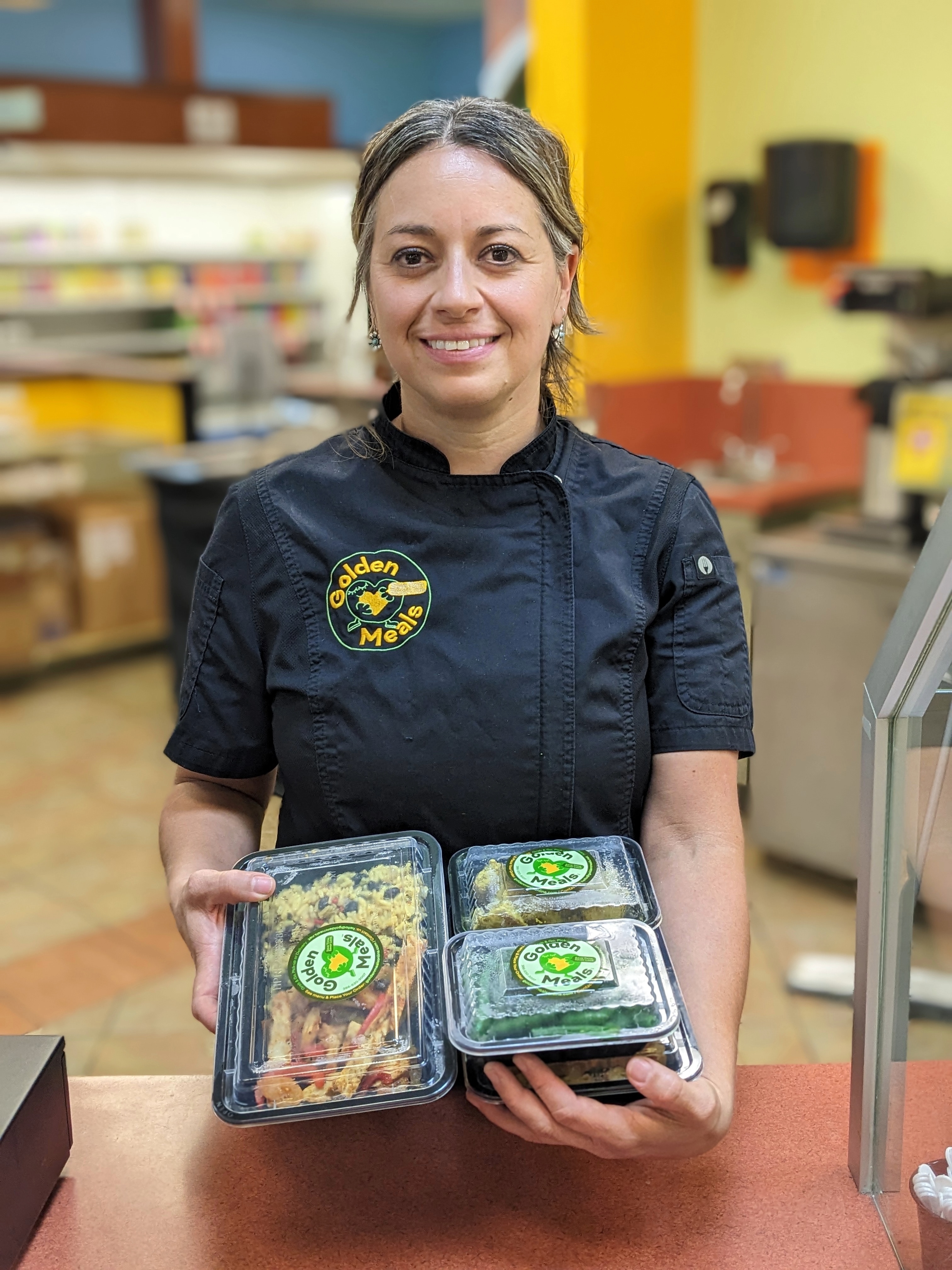
Nora doesn’t shy away from talking about the hurdles. “The recession in 2008 hit us hard,” she remembers. “We had to get creative - package deals, specials, anything to bring people in.” Then came the hurricanes, five in their first year in Florida. And of course, COVID lockdown.
“That was one of the toughest. We had no staff. It was just me, my brother, my nephew, my niece. We were cooking, cleaning, delivering — everything. But we made it. That’s what matters.”
For other small business owners, she offers a simple but powerful reminder: “You just keep going. You pivot, you adapt, you lean on your family and your community. And you never lose sight of why you started.”
📍 Located inside the Natural Market
🕚 Open Monday–Friday, 11 AM to 3 PM
📱 Order online or through the Golden Meals app
🚚 Free delivery available for local orders
Whether you're a parent looking for healthier alternatives, a student in need of quick fuel, or a senior seeking convenient meals that actually taste good — Golden Meals has something on the menu for you.
Forget Growth for Growth’s Sake. Scale Your Company With Purpose!
Every business owner dreams of growth—the big contracts, the expanding team, the larger facility. Growth is exciting, but what happens when it outpaces your ability to sustain it? For small to mid-sized business owners, the challenge isn’t just getting bigger—it’s growing profitably. Scale too quickly, and you could find yourself losing control of your business. Scale too cautiously, and you risk stagnation. So, how do you strike the right balance?
The Growth Trap: A Cautionary Tale
Imagine you own a manufacturing company, and a massive order comes in. It’s a dream deal—10,000 units instead of the usual 1,000. You scramble to increase production, hiring new employees, ordering more materials, even taking on debt to finance the expansion. But a few months later, you realize you’re barely breaking even. The new employees aren’t fully trained yet, production costs have skyrocketed, and cash flow is tight. Your profit margins, which seemed healthy before, are now razor-thin. Worse, your suppliers have increased their prices due to the larger volume, but you didn’t adjust your pricing in time. You’re now operating at a loss, despite the influx of new business.
This scenario is all too common. Growth, if not managed wisely, can erode profits instead of increasing them. The key? Strategic scaling.
Profitability First, Expansion Second
In the early days, you might not be profitable, and that’s okay. Many businesses start in the red, investing in marketing, product development, and hiring. However, you must ensure you’re not losing money per product. If each unit costs $12 to make and you sell it for $10, no amount of scaling will save you—you’re just multiplying losses.
Similarly, new employees take time to become profitable. Hiring is an investment in growth, but it often takes months before an employee generates more revenue than they cost. Business owners must anticipate this ramp-up period and avoid over-hiring too soon.
Where to Focus Your Growth
Not all growth is created equal. The most efficient areas of expansion are those where costs scale more slowly than revenue. Prioritize these strategies:
Controlled Growth vs. Losing Control
Growth is exhilarating, but it must be controlled. Many business owners get so caught up in expansion that they give up too much equity, bringing in investors who eventually take control. Others overextend, running out of cash when things don’t go as planned.
Instead, keep growth sustainable:
Avoid Growth for Growth’s Sake
It’s easy to get caught up in vanity metrics—chasing higher sales, expanding into new markets, or acquiring more customers—without asking whether that growth actually benefits the business. But growth is not a goal in itself; it should be a means to an end. Every expansion initiative should answer a fundamental question: Will this make my business stronger in the long run? If the answer isn’t clear, it may be a sign to reassess.
Strategic growth means planning ahead. Before you leap, have a roadmap. Set clear, measurable goals, such as: “We aim to increase production by 50% over the next 18 months, which should yield a 20% revenue increase while maintaining a 15% profit margin.” This approach ensures that growth aligns with financial health, rather than just inflating top-line revenue while squeezing profits.
Smart business owners don’t just chase expansion; they balance growth with profitability. They scale strategically, ensuring each step forward is sustainable, and never lose sight of their core business strengths. With a steady hand, you can grow your company without losing control of it—and that’s the real measure of success.
Forget Growth for Growth’s Sake. Scale Your Company With Purpose!
Every business owner dreams of growth—the big contracts, the expanding team, the larger facility. Growth is exciting, but what happens when it outpaces your ability to sustain it? For small to mid-sized business owners, the challenge isn’t just getting bigger—it’s growing profitably. Scale too quickly, and you could find yourself losing control of your business. Scale too cautiously, and you risk stagnation. So, how do you strike the right balance?
The Growth Trap: A Cautionary Tale
Imagine you own a manufacturing company, and a massive order comes in. It’s a dream deal—10,000 units instead of the usual 1,000. You scramble to increase production, hiring new employees, ordering more materials, even taking on debt to finance the expansion. But a few months later, you realize you’re barely breaking even. The new employees aren’t fully trained yet, production costs have skyrocketed, and cash flow is tight. Your profit margins, which seemed healthy before, are now razor-thin. Worse, your suppliers have increased their prices due to the larger volume, but you didn’t adjust your pricing in time. You’re now operating at a loss, despite the influx of new business.
This scenario is all too common. Growth, if not managed wisely, can erode profits instead of increasing them. The key? Strategic scaling.
Profitability First, Expansion Second
In the early days, you might not be profitable, and that’s okay. Many businesses start in the red, investing in marketing, product development, and hiring. However, you must ensure you’re not losing money per product. If each unit costs $12 to make and you sell it for $10, no amount of scaling will save you—you’re just multiplying losses.
Similarly, new employees take time to become profitable. Hiring is an investment in growth, but it often takes months before an employee generates more revenue than they cost. Business owners must anticipate this ramp-up period and avoid over-hiring too soon.
Where to Focus Your Growth
Not all growth is created equal. The most efficient areas of expansion are those where costs scale more slowly than revenue. Prioritize these strategies:
Controlled Growth vs. Losing Control
Growth is exhilarating, but it must be controlled. Many business owners get so caught up in expansion that they give up too much equity, bringing in investors who eventually take control. Others overextend, running out of cash when things don’t go as planned.
Instead, keep growth sustainable:
Avoid Growth for Growth’s Sake
It’s easy to get caught up in vanity metrics—chasing higher sales, expanding into new markets, or acquiring more customers—without asking whether that growth actually benefits the business. But growth is not a goal in itself; it should be a means to an end. Every expansion initiative should answer a fundamental question: Will this make my business stronger in the long run? If the answer isn’t clear, it may be a sign to reassess.
Strategic growth means planning ahead. Before you leap, have a roadmap. Set clear, measurable goals, such as: “We aim to increase production by 50% over the next 18 months, which should yield a 20% revenue increase while maintaining a 15% profit margin.” This approach ensures that growth aligns with financial health, rather than just inflating top-line revenue while squeezing profits.
Smart business owners don’t just chase expansion; they balance growth with profitability. They scale strategically, ensuring each step forward is sustainable, and never lose sight of their core business strengths. With a steady hand, you can grow your company without losing control of it—and that’s the real measure of success.
Cash flow is the lifeblood of any business. Whether you're managing a commercial construction firm or running a retail operation, understanding how money moves in and out of your business is key to long-term success. Poor cash flow management can leave businesses scrambling to cover expenses, even when profits look good on paper.
A recent episode of the Expandable Series discussed this in detail, but here are some fundamental cash flow principles, using commercial construction as an example, that apply to businesses across all industries.
1. Understand Your Cash Outflows
In commercial construction, significant cash outlays are required upfront for raw materials, permits, and labor. These costs must be covered well before payments from clients arrive. Similarly, in retail, manufacturers need to purchase inventory long before customers make a purchase.
A business must have enough cash on hand to cover these expenses. Without it, operations may stall, delaying projects and impacting profitability. Understanding your cash needs ahead of time ensures smoother financial management.
Example: Imagine a mid-sized construction firm, Apex Builders, takes on a new commercial office project. Before the first payment arrives, they must pay for steel beams, concrete, and skilled labor. Without proper cash reserves or a well-structured payment schedule, Apex Builders could struggle to cover these costs, potentially halting the project and damaging their reputation.
2. Time Your Cash Inflows Strategically
Revenue in commercial construction typically comes from milestone payments throughout a project or upon completion. However, these payments can be delayed due to contract terms, client approvals, or unexpected issues.
For any business, it’s essential to analyze how long it takes to convert expenses into revenue. Are you waiting 30, 60, or even 90 days to get paid? If so, your business must be structured to withstand these gaps. Ensuring that your contract terms align with your cash flow needs can prevent unnecessary financial strain.
Example: Apex Builders structures their contracts to ensure payments are received at key milestones—such as after the foundation is laid, after framing is completed, and upon final inspection. By planning these payment intervals, they reduce financial stress and ensure they always have working capital.
3. Build a Cash Buffer
One of the best strategies for managing cash flow is to build a buffer that accounts for timing discrepancies. In construction, this means having enough reserves to cover payroll and material costs while waiting for payments. The same principle applies to any business with delayed payments.
This buffer should be built into your pricing. Instead of operating on razor-thin margins, factor in potential delays and unexpected costs when setting your rates. This ensures financial stability even during slower payment periods.
Example: Apex Builders includes a 10% contingency in their project bids, ensuring that if a client delays payment or unexpected costs arise, they have the liquidity to keep operations running smoothly.
4. Plan for Payroll and Fixed Expenses
Payroll is a non-negotiable expense in any business. Employees expect timely paychecks, and failure to meet payroll obligations can lead to operational disruptions and even legal consequences.
Since payroll and other fixed expenses (like rent, utilities, and insurance) don’t change based on revenue fluctuations, they must be accounted for in advance. Forecasting these expenses over the next quarter will help ensure you always have the necessary funds available.
Example: Apex Builders schedules payments from previous projects to help cover payroll during slow months, ensuring that employees are always paid on time.
5. Look Ahead to the Next Quarter
Successful businesses don’t just think about today’s cash flow—they plan for the next quarter and beyond. What projects are in the pipeline? When will revenue from those projects be realized? What expenses need to be covered in the meantime?
By forecasting cash flow and preparing for potential shortfalls, businesses can make informed decisions about when to invest, when to hold back, and when to seek additional financing options to bridge any gaps.
Example: Apex Builders maintain a rolling cash flow projection, helping them anticipate slow periods and ensuring they never take on more projects than they can financially support at one time.
The Bottom Line
Cash flow management isn’t just about tracking numbers—it’s about planning ahead, building flexibility into your pricing, and ensuring your business can withstand the natural ebbs and flows of financial cycles. Whether you’re in commercial construction, retail, or any other industry, mastering cash flow is essential for long-term success. Surety Bank is here to help businesses navigate these challenges with financial solutions designed to keep operations running smoothly.
As more banking moves online, security has become just as important as convenience. Whether you’re checking a personal account or managing company finances, your computer habits play a critical role in keeping your information safe. A few consistent practices can greatly reduce your risk of fraud and protect sensitive data.
Malware can capture keystrokes, steal login credentials, and access personal files without you realizing it. To stay protected:
Make full use of the security tools your devices and bank provide:
Closing your browser window isn’t enough to end your session.
Browsers can store sensitive information like login pages or cached credentials. To protect yourself:
Phishing emails and fraudulent pop-ups can trick you into giving away banking information. Watch for:
Best practice: Always access your bank by typing the official web address directly into your browser, never through email or ad links.
Businesses face higher risks, so proactive steps are essential:
Online banking can be safe and reliable when paired with good cybersecurity habits. By:
…you can protect both your finances and your peace of mind.
The key is consistency. Security isn’t a one-time task—it’s a set of habits built into your everyday banking routine. Taking these steps ensures your accounts remain secure, your sensitive information stays private, and you can manage your finances confidently, whether personally or for your business.
In the heart of downtown, amidst the vibrant pulse of local eateries and community events, there’s a name that keeps coming up: Chef Nora. If you’ve dined at De La Vega, you’ve likely experienced her artistry on a plate. But beyond the signature flavors and culinary finesse, there's a deeper, richer story — one of family, perseverance, and community love. And now, with her latest venture, Golden Meals, Chef Nora is cooking up something even more personal.
Chef Nora’s journey into the restaurant world began two decades ago when she and her family — her parents, brother, and sister — moved from New Mexico to Florida. They left behind everything familiar on the word of a family friend who saw promise in a vacant restaurant spot downtown.
With only a bit of restaurant experience between them, they leapt into entrepreneurship. “It wasn’t just a job,” Nora recalls. “I had already worked in restaurants. I realized what I really wanted was to have my own.” The family rallied around her dream — a move that not only shaped their livelihoods but also laid the groundwork for something bigger than any one of them could have imagined.
Their first venture was De La Vega — a name that not only carried their family heritage but symbolized their growing identity in the community. “We started with Tex-Mex,” Nora explained, “but quickly realized there were too many of those already. So we pivoted to something unique: Latin fusion with a tapas concept.”
It was a family effort from the start. Nora spearheaded the menu, crafting recipes with creativity and care, while her brother took on the general manager role. “It was our school,” she says. “Everything we’ve learned in the past 20 years, we learned by doing.”
Today, De La Vega is more than a restaurant — it’s a beloved local fixture. With loyal customers, an ever-evolving menu, and a consistent focus on flavor, it’s the kind of place that gets recommended again and again.
The concept for Golden Meals was born not in a commercial kitchen, but in Nora’s own home. “My dad was living in the senior apartments, and I used to make meals for him — healthy, ready to eat, so he didn’t have to cook.” After he passed away three years ago, Nora found herself talking to his neighbors — many of whom had similar needs. The idea began to take shape: a meal service designed to support seniors, promote wellness, and most importantly, taste amazing.
But what started as a personal project in memory of her father has grown into something with far wider impact.
While initially conceived as a service for seniors, Golden Meals quickly found a broader audience. “Everyone needs healthy food — busy moms, students, professionals,” Nora notes. “We realized this wasn’t just about one group. It’s for anyone who wants quick, affordable, and nutritious meals.”
When a deli inside a local natural market became available, the opportunity felt serendipitous. “Everything was ready — the kitchen, the space. We just had to bring the concept and the heart.”
Golden Meals officially opened its doors four months ago, operating weekdays from 11 a.m. to 3 p.m. It functions as both a grab-and-go cafe and a meal delivery service, offering flexible access for people with packed schedules or limited mobility. And yes — delivery is currently free.
Unlike De La Vega’s Latin fusion focus, Golden Meals is all about clean, fresh ingredients and variety. “We’re not tied to any one cuisine here. We can offer pasta, Asian dishes, vegan options — whatever inspires us and serves our community.”
Everything is made in-house, from scratch. Think: vibrant green beans sautéed with garlic and olive oil, sweet potatoes roasted to perfection, and macaroni salad that’s light but packed with flavor. Sodium and sugar are kept low; flavor is boosted with herbs and spices, not additives.
“We don’t want ‘healthy’ to mean boring,” Nora laughs. “You can eat well and still love every bite.”
Why the name Golden Meals? It’s a tribute to Nora’s father and the community he was part of. “It started with the idea of serving those in their golden years,” she says. “But now it means meals that are golden in quality, golden in purpose. Meals that make you feel good.”
Nora doesn’t shy away from talking about the hurdles. “The recession in 2008 hit us hard,” she remembers. “We had to get creative - package deals, specials, anything to bring people in.” Then came the hurricanes, five in their first year in Florida. And of course, COVID lockdown.
“That was one of the toughest. We had no staff. It was just me, my brother, my nephew, my niece. We were cooking, cleaning, delivering — everything. But we made it. That’s what matters.”
For other small business owners, she offers a simple but powerful reminder: “You just keep going. You pivot, you adapt, you lean on your family and your community. And you never lose sight of why you started.”
📍 Located inside the Natural Market
🕚 Open Monday–Friday, 11 AM to 3 PM
📱 Order online or through the Golden Meals app
🚚 Free delivery available for local orders
Whether you're a parent looking for healthier alternatives, a student in need of quick fuel, or a senior seeking convenient meals that actually taste good — Golden Meals has something on the menu for you.


Surety Bank continually works to provide greater accessibility to all of its products and services. If you have any questions about accessible banking, call us at 386-734-1647
© 2026 Surety Bank