


Other Resources
ALL ARTICLES


Community
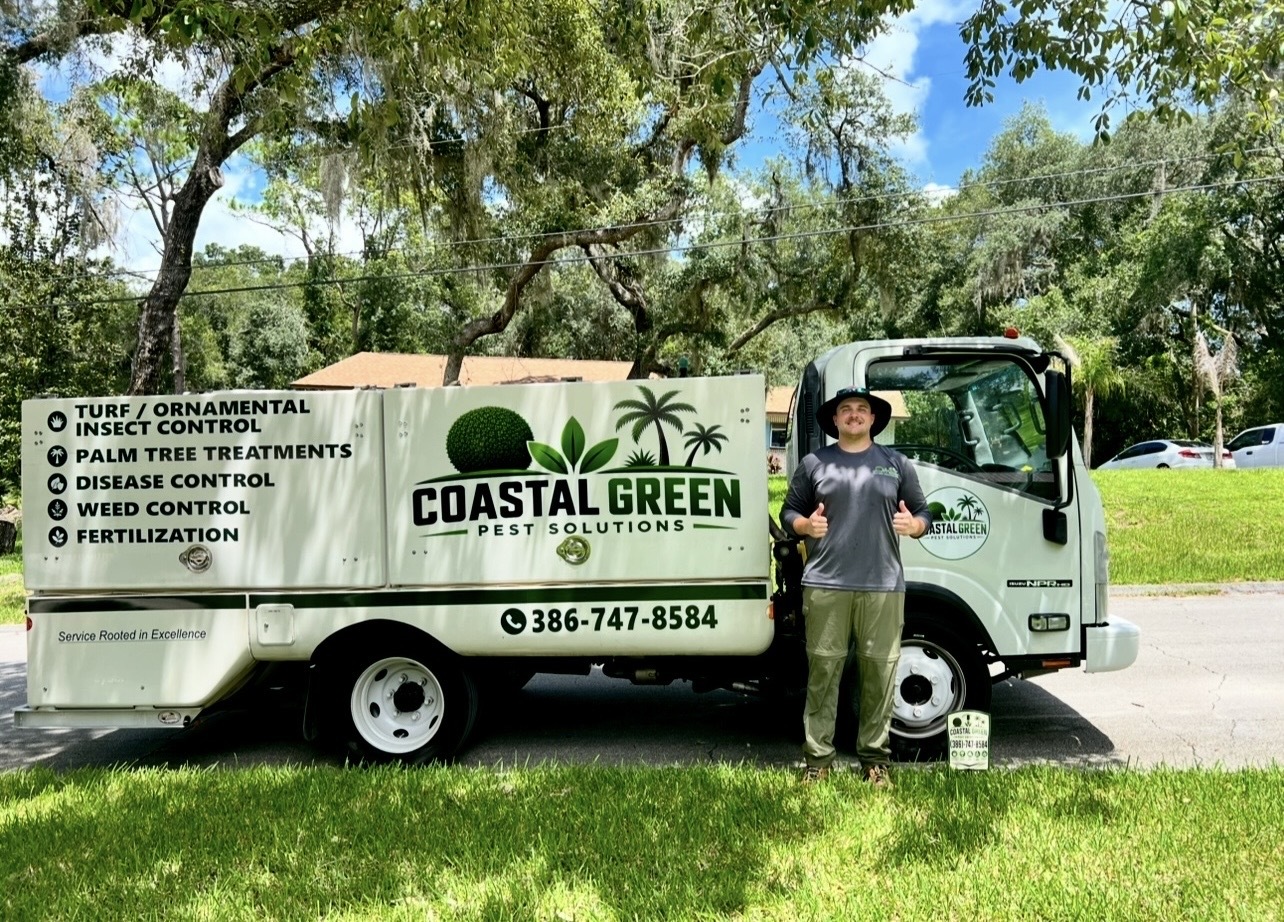
Growing Something of His Own: How DeLand’s Austin Scott Launched Coastal Green Pest Solutions
LEARN MORE
Personal Banking, Online Banking
Lorem ipsum dolor sit amet, consectetur adipiscing elit. Suspendisse varius enim in eros elementum tristique. Duis cursus, mi quis viverra ornare, eros dolor interdum nulla, ut commodo diam libero vitae erat. Aenean faucibus nibh et justo cursus id rutrum lorem imperdiet. Nunc ut sem vitae risus tristique posuere.
Stay informed with out regularly updated resources. Each post convers a unique aspect of banking or finance to enhance your understanding and enable better financial decisions.
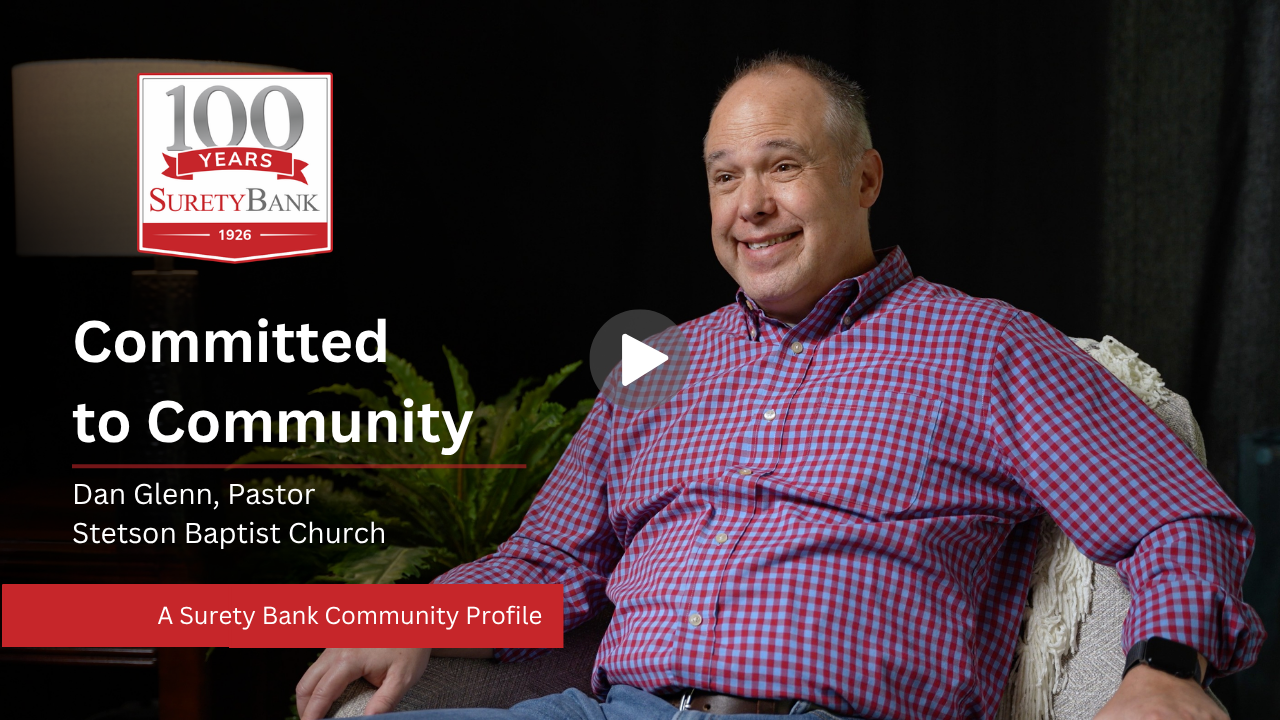
For Dan Glenn, Pastor of Stetson Baptist Church in DeLand, Surety Bank has become much more than the place where the church did its banking. Over the years, the initial banking relationship has grown into a partnership centered around a shared commitment to the community.
That partnership took on new meaning in 2018 when Stetson Baptist Church launched Night to Shine, an unforgettable prom experience for people with special needs held in partnership with the Tim Tebow Foundation.
Creating an experience like Night to Shine requires significant support, and Surety Bank was one of the event's earliest sponsors.
“Surety was one that came on very early saying, ‘Hey, we want to support that. We want to be a part of it.’”
For Dan, that moment marked a shift in the relationship. It became much more personal and community focused.
Surety continued supporting Night to Shine year after year, but one experience in particular showed Dan what that partnership truly meant.
After the first Night to Shine, Dan realized the church had never properly thanked Surety for its sponsorship. When it came time to plan the event again, he felt hesitant approaching Surety for another year of support.
The response surprised him.
There was no hesitation. Surety wanted to be involved again.
Years later, that commitment went even further when Surety reached out to the church without being asked and offered to increase its support.
“They have an intention to be generous, even when generosity may or may not be expected or requested.”
For Dan, that willingness to look for opportunities to make a greater impact is part of what distinguishes Surety Bank as a community organization.
Instead of simply waiting for someone to present a sponsorship request, Surety has been willing to ask a different question: How can we do more?
That philosophy extends beyond a single event.
Dan describes Surety not simply as a community bank, but as a “community-centered organization” that genuinely cares about DeLand and the relationships it has built throughout the city.
That personal connection is something Dan has experienced firsthand. His relationship with Surety isn't limited to the organization itself. It's also built through relationships with the people behind it.
As Surety Bank celebrates 100 years, Dan believes that commitment to people and community helps explain why the bank has remained part of DeLand for generations.
Over the past century, both the bank and the city have grown and changed. Yet Surety has continued to serve the community throughout that growth.
For Dan, that's exactly why Surety's 100th anniversary message, “How we've always done it is how we'll always do it,” resonates.
“The way they've always done things has been people centered, relationships centered, community centered.”
Those values create something that goes beyond banking. They create trust. They allow organizations like Stetson Baptist Church to know what to expect from a partner that has consistently shown up before and intends to continue showing up in the future.
After years of partnership, Dan hopes that part of Surety never changes.
This is how Surety Bank has always done it. It's how we will always do it.


For Austin Scott, starting a business wasn’t the result of a lifelong plan. It was something that grew over time, much like the lawns he now helps his customers care for.
Born and raised in DeLand, Austin is the owner of Coastal Green Pest Solutions, a new Volusia County business specializing in lawn treatments, pest management, fertilization, and the care of palms and shrubs.
The company may be new, but Austin is far from new to the work.
Before entering the lawn and pest control industry, Austin was selling auto parts at O’Reilly Auto Parts. Then a landscaper friend suggested he take a job with a local pest control company.
He gave it a shot and discovered an industry that fascinated him.
“I like that I could learn something new every day,” Austin says. “You get to see different problems, and you get to see the benefits of your own labor making a lawn beautiful. You get to see it go from nothing to something.”
Austin spent nearly six years in the industry, gradually developing an understanding of not only what products to use, but why lawns develop problems in the first place.
Interestingly, the work even gave him a new appreciation for a subject he once struggled with: chemistry.
In school, chemistry had never come naturally to Austin. But working with fertilizers, herbicides, insecticides, fungicides, and nutrients gave those concepts a real-world application.
“You get to learn something and then apply it directly,” he says.
And the more Austin learned, the more he realized there was an opportunity to do things differently.
Austin believes one of the biggest shortcomings in the lawn and pest control industry isn't necessarily the products or treatment programs companies use. It's the communication that happens, or doesn't happen, between the company, technician, and homeowner.
A lawn problem can be the result of insects, fungus, nutrient deficiencies, irrigation issues, environmental stress, or a combination of factors. Simply treating the symptom doesn't always solve the underlying problem.
Austin wants Coastal Green Pest Solutions to be different.
“I take pride in being the solution and the end to the revolving door when it comes to these lawn programs,” he says.
That means spending time with homeowners, explaining what is happening on their property, and helping them understand what needs to change.
Austin compares a lawn or landscape to the human body. One problem can affect the health of the entire system. Killing an insect, for example, may address the immediate issue, but it doesn't necessarily explain why the lawn became susceptible to the pest in the first place.
“If you can be the middleman between the problem, the chemicals, and the customer, and you can explain all that smoothly, that's normally the end,” Austin says. “A lot of people don't take the time to talk to their customers and make sure they understand.”
It's an approach built around education and relationships as much as treatment.
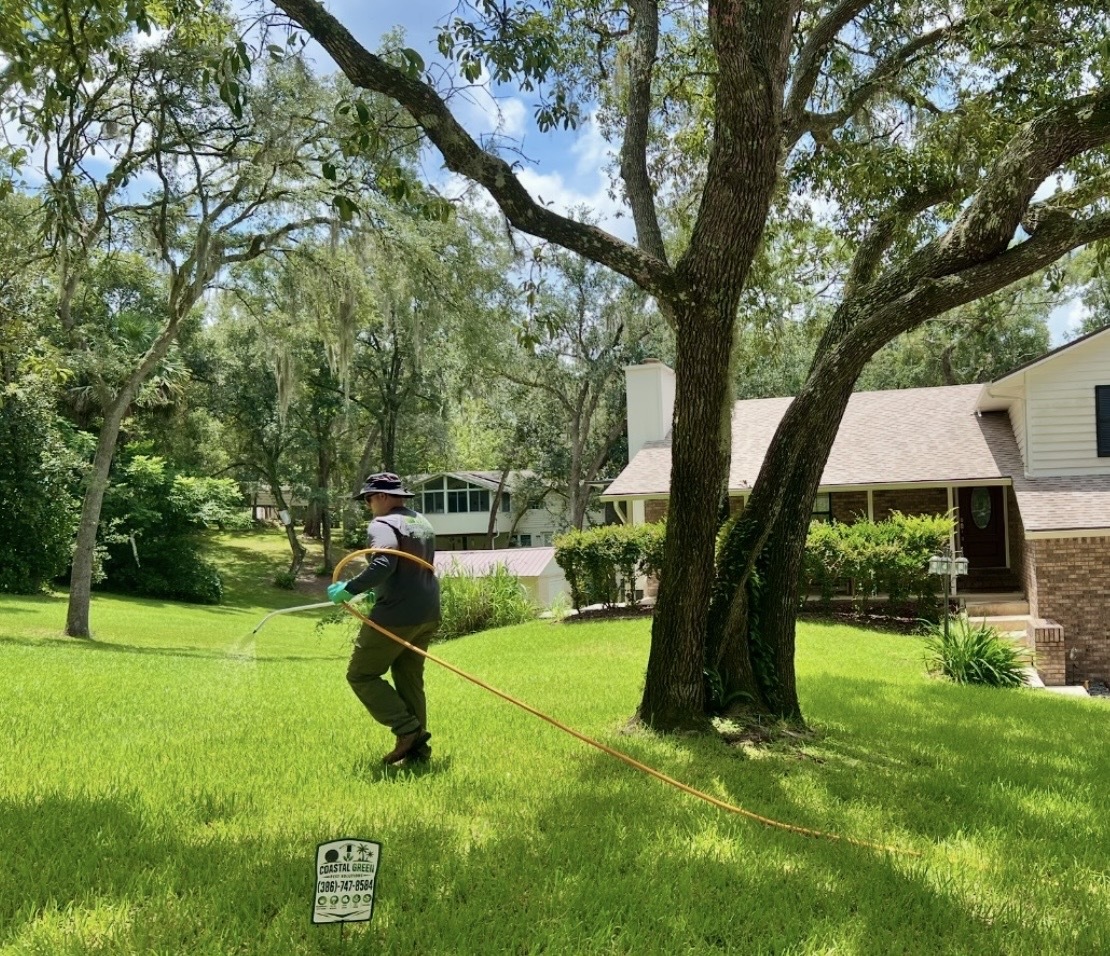
When the company Austin had worked for was sold, he saw an opportunity to take everything he'd learned and build something of his own.
Coastal Green Pest Solutions was born.
Today, Austin primarily works with residential customers throughout Volusia County who care about the long-term health and appearance of their properties.
His services include:
Austin's philosophy isn't about simply “spraying and praying,” as he puts it. Every property is different, so understanding what's actually happening comes before recommending a solution.
That philosophy also shapes how he plans to grow the business.
Starting a company requires more than expertise and ambition. There are trucks, equipment, products, operating expenses, and the reality that revenue doesn't necessarily arrive the moment the business opens its doors.
Austin knew he needed some financial breathing room as he got Coastal Green Pest Solutions off the ground.
That's where Surety Bank came in.
Austin first learned about Surety through his father, who had worked in real estate and developed a relationship with Surety Bank CEO Ryan James over the years.
When Austin was preparing to launch Coastal Green Pest Solutions, that local connection opened the door to a conversation.
“I was just looking for a good little loan—something to get me by, that way I had a little bit of breathing room,” Austin says. “I was very questionable on how I was going to make everything work, and honestly, I'm very grateful for Surety stepping in.”
Surety provided a business loan directly to Coastal Green Pest Solutions, giving Austin additional resources and flexibility during the critical early months of building the company.
For Austin, the experience demonstrated one of the advantages of working with a community bank: relationships matter.
Ryan knew Austin's family. He'd seen Austin working around town. And instead of Austin simply being another application, there was an opportunity to understand the person and business behind it.
That trust helped a local entrepreneur take the next step.
Just a couple of months into the business when we spoke with him, Austin already had big ambitions for Coastal Green Pest Solutions.
Eventually, he'd like to have multiple trucks on the road, a dedicated irrigation team, a sales team, and expanded services including home pest and termite control.
But he's in no hurry to grow simply for the sake of getting bigger.
Austin wants to make sure the service and customer experience that distinguish Coastal Green today remain intact as the company expands.
“If I'm not taking the time to personalize your service and making sure that I'm putting down what I'm promising, then there's no point in me opening up the next step,” he says.
He describes his philosophy simply as “natural growth or no growth.”
It's an especially fitting philosophy for someone who spends his days helping things grow.
For now, Austin is focused on building relationships, earning the trust of homeowners and landscapers throughout Volusia County, and developing Coastal Green one customer at a time.
And he's doing it in the community he has always called home.
“I still enjoy the small-town aspect of DeLand,” Austin says. “Raising a family here, having good friends here, it's very nice. DeLand's a good home base.”
As DeLand and Volusia County continue to grow, Austin hopes Coastal Green Pest Solutions will grow right alongside them, without losing the personal relationships that helped get the business started in the first place.
Coastal Green Pest Solutions serves homeowners throughout Volusia County. For homeowners who care about the health and appearance of their lawn and landscaping, Austin and Coastal Green provide personalized lawn treatment, pest management, fertilization, and plant health solutions.
Personal fraud continues to evolve, and scammers are finding increasingly sophisticated ways to target consumers. From AI-powered messages that appear surprisingly convincing to attempts to gain access to entire financial accounts. Recognizing the warning signs is becoming more important than ever.
While you can't prevent every fraud attempt, knowing what to watch for and taking a few proactive steps can make it much harder for scammers to succeed.
Artificial intelligence is making fraudulent calls and text messages feel more personal and legitimate. Scammers can use AI to create convincing communications designed to make you believe you're interacting with a trusted person or organization.
Be cautious when you receive an unexpected call or message asking for personal information, money, or access to an account. Before responding or taking action, reach out to Surety Bank directly to verify they are the ones calling. This step could mean not being scammed out of your money.
Fraudsters are increasingly looking beyond individual credit card numbers and attempting to gain access to entire financial profiles, including personal bank and investment accounts.
Protect your accounts by regularly reviewing activity for transactions you don't recognize and using multifactor authentication whenever it's available. Never provide your password, login credentials, or verification codes to someone who contacts you unexpectedly.
If you notice something unusual in your Surety Bank account, contact us promptly.
Older adults continue to be frequent targets of financial scams, particularly those involving tech support and investment-related schemes.
These scams often rely on urgency or fear to convince someone to act before they have an opportunity to question what's happening. Talk with older family members about common scams and encourage them to check with someone they trust before sending money or providing sensitive information in response to an unexpected request.
Taking a few minutes to verify a situation can help prevent a significant financial loss.
Protecting yourself doesn't require becoming a fraud expert. Start by being skeptical of unexpected requests for money or information, especially when someone pressures you to act immediately.
Use strong, unique passwords and enable multifactor authentication when available. Avoid clicking links in unexpected emails or text messages, and regularly review your bank accounts and credit reports for activity you don't recognize.
Most importantly, trust your instincts. If something doesn't feel right, stop and verify before taking action.
If you'd like to take additional steps to protect yourself, here are three resources worth exploring:
FTC IdentityTheft.gov
Best for someone who thinks their identity has already been compromised. The FTC provides a personalized recovery plan and steps for addressing identity theft.
Visit IdentityTheft.gov
FTC Credit Freeze & Fraud Alert Guide
Customers can place a free credit freeze, which can prevent identity thieves from opening new credit accounts in their name, or add a fraud alert.
Learn About Credit Freezes & Fraud Alerts
Aura
For those interested in a paid protection service, Aura offers identity and financial monitoring tools and other fraud-protection features. I’d position this as an optional third-party tool, not something Surety is recommending over other services.
Explore Aura
These resources are provided for informational purposes. Surety Bank does not endorse or guarantee any third-party product or service.
Fraud tactics will continue to change, but one of your strongest defenses is also one of the simplest: slow down.
Scammers often depend on creating urgency so you act before thinking. If you're unsure about a request involving your Surety Bank account, don't rely on the phone number, link, or contact information provided in the message. Contact Surety Bank directly through a trusted channel.
We're here to help you protect your financial information and recognize potential fraud before it becomes a loss.
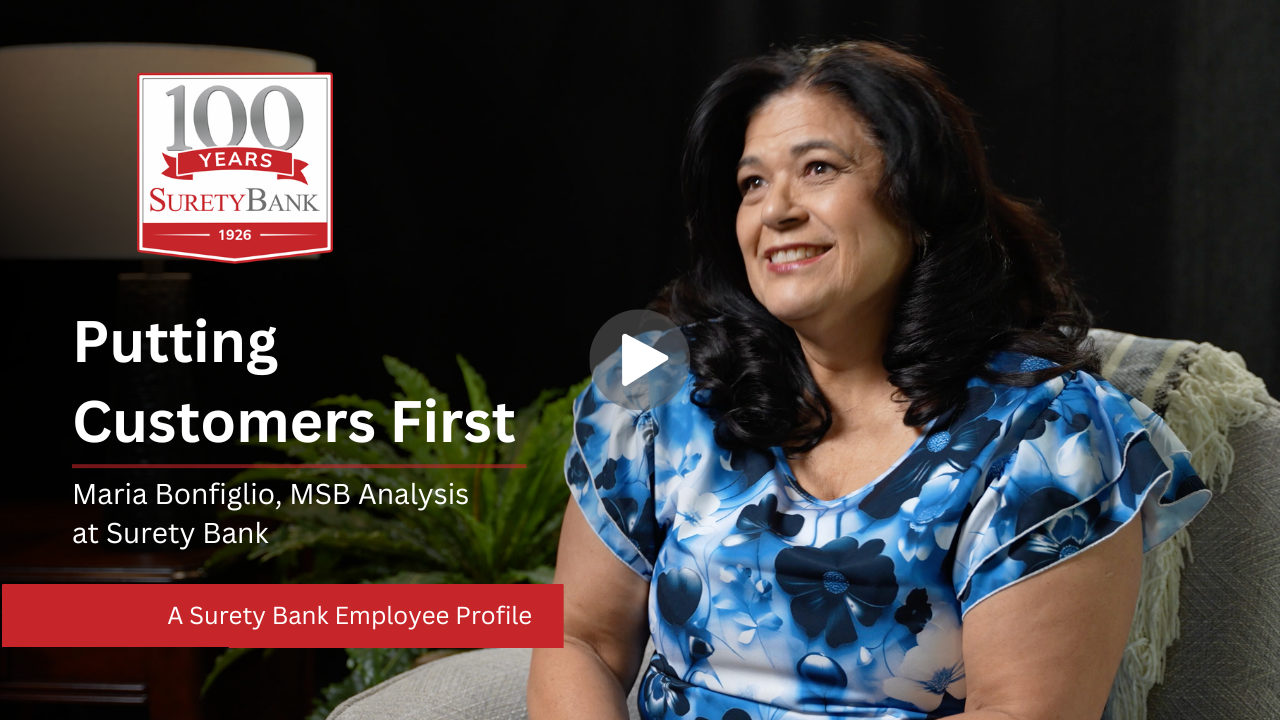
For Maria Bonfiglio, working at Surety Bank has always been about more than banking. It's about taking care of people.
Maria has been part of the Surety Bank family for nine years, but her journey began with a simple text message. A former boss she had stayed in touch with reached out years after they had worked together and told her, "I have the perfect job for you." Maria's response was simple: "Where should I sign?"
Nine years later, her enthusiasm hasn't changed.
"I love it. I love my job."
Over the years, Maria's role has evolved, giving her the opportunity to learn new skills and develop deeper relationships with customers. She has gotten to know some of them so well that she can recognize who is calling just by the sound of their voice. For Maria, those relationships are what make Surety feel less like a workplace and more like a family.
That personal connection also shapes the way Maria approaches protecting customers.
When something doesn't seem right, she isn't afraid to ask questions. Whether she's reviewing a check or helping someone resolve an issue with an account, Maria understands that taking a little extra time can make a significant difference.
"We really care about our customers," Maria explains. Even when customers may wonder why the bank is asking additional questions, she wants them to understand the reason behind it. "We don't want them to lose money."
For Maria, that care isn't limited to customers. She has experienced it personally as an employee.
During some of the most difficult moments of her life, including an extended hospital stay and the loss of her son, Maria remembers her Surety family checking on her, visiting her, and making sure she knew she wasn't alone. Those experiences showed her that the relationships Surety talks about aren't simply something customers experience. They're part of the culture inside the bank, too.
It's also why Maria believes Surety Bank has remained part of the community for 100 years. She has worked at other banks, but says Surety's involvement in the community feels different. The bank isn't trying to be the biggest. Instead, it has remained focused on the people and communities it serves.
That same philosophy comes through in Maria's relationships with her customers. Some have developed such a strong connection with her that when they call, they specifically ask for Maria. She takes pride in being someone they know they can turn to when they have a question or need assistance.
After nine years, Maria still says thank you for the opportunity that brought her to Surety Bank. Her story is a reminder that relationship banking begins with people who genuinely care about the people on the other side of the counter or phone.
This is how Surety Bank has always done it. It's how we will always do it.
.png)
For Lewis Long III, banking with Surety Bank is a relationship that has lasted more than five decades.
As one of Surety Bank's longest-standing customers, Lewis has watched the bank grow alongside the community since his connection to Surety began more than 50 years ago. He originally opened a savings account after hearing from neighbors that the bank consistently offered strong value and genuinely cared about its customers.
Over the years, Lewis has seen a lot of change. He remembers making deposits with a passbook while employees manually updated balances using a hand-cranked adding machine. What hasn't changed, however, is the way Surety Bank treats the people who walk through its doors.
For Lewis, that commitment extends beyond his own banking experience. When his sons were born, he opened accounts for each of them at Surety Bank, continuing a family tradition that has now spanned generations. One of his sons even participated in the ribbon-cutting ceremony when Surety Bank dedicated its current building in the early 1990s.
Throughout his life of military service, public service, and community involvement, Lewis has always returned to the same bank.
What has kept him loyal all these years?
The answer is simple: people.
"You couldn't ask for better service or better people," Lewis says. "I don't know how they remember everybody's name that walks in the door, but they do. They're just super folks. The people have always been a gift to us and to the community."
Lewis believes that the values Surety Bank was founded on continue to define the bank today. One story from the bank's early history has always stayed with him. During the Great Depression, he recalls hearing that Surety worked with customers rather than rushing to foreclose on them because they cared more about helping people than taking their property. That philosophy, he says, is still reflected in the way the bank serves its customers today.
It's one of the reasons Lewis has become an advocate for the bank wherever he goes.
Whether he's encouraging friends to open a money market account, sharing the bank's history, or even suggesting a new Surety branch for his hometown of Lake Helen, Lewis proudly recommends the bank he's trusted for more than half a century.
"I wouldn't champion the bank if I didn't believe in these folks and believe in this bank," he says. "Everybody is important. They see past whatever's bothering someone that day and still treat people with kindness and respect."
As Surety Bank celebrates 100 years of serving Central Florida, customers like Lewis remind us that while banking has evolved, some things should never change. Genuine relationships, exceptional service, and a commitment to the community remain at the heart of everything we do.
This is how Surety Bank has always done it. It's how we will always do it.
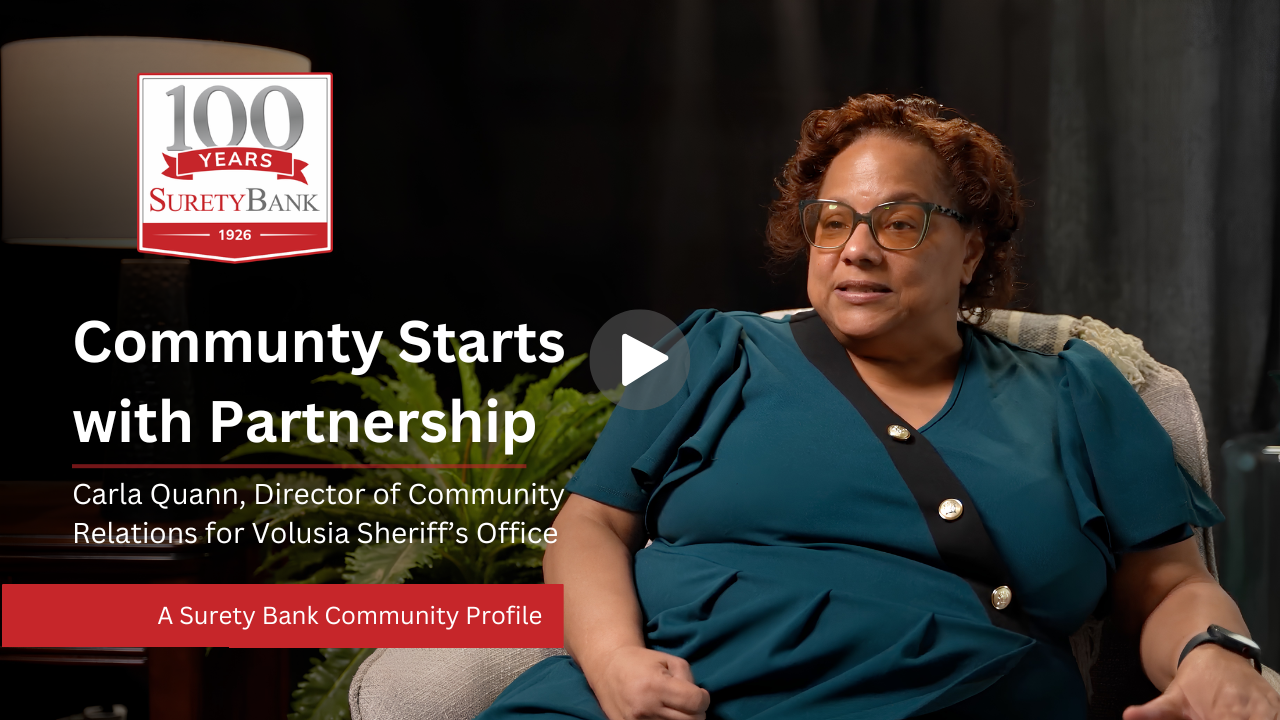
For 100 years, Surety Bank has believed that community banking means more than serving customers inside the walls of a branch. It means investing in the people, organizations, and partnerships that help our communities thrive.
That commitment is something Carla Quann, Director of Community Relations for the Volusia Sheriff's Office, has experienced firsthand.
"Our goal is to support everyone in our community," Carla explains. "Ryan [James] wanted to be a part of what we're doing because he cares about the community."
The partnership between Surety Bank and the Volusia Sheriff's Office began when Surety Bank President & CEO Ryan James joined the Volusia Sheriff's Foundation Board. Since then, the relationship has grown into a collaborative effort focused on addressing some of the community's greatest needs.
One example came during the holiday season, when thousands of local families faced uncertainty after SNAP benefits were unexpectedly interrupted. Through the combined efforts of businesses, volunteers, and community organizations, more than 3,500 grocery bags were distributed to families throughout Volusia County.
According to Carla, Surety Bank was an important part of making that effort possible.
Beyond community events and charitable initiatives, the partnership has also helped strengthen public safety.
As financial scams targeting older adults became increasingly common, Surety Bank worked alongside the Sheriff's Office to provide education, share industry expertise, and help detectives better recognize the warning signs of fraud.
That collaboration ultimately helped lead to the creation of the Volusia Sheriff's Office Financial Crimes Unit—a dedicated team focused on protecting residents from fraud and financial exploitation.
Working together, those efforts have helped recover more than $2 million for local victims of financial crimes.
For Carla, those results reflect what makes Surety Bank different.
"They're not just another hometown bank," she says. "They care about their community."
She believes that commitment starts with customer service but extends far beyond banking. Whether supporting nonprofit organizations, helping law enforcement address emerging scams, or simply answering the phone when someone needs help, Surety Bank has built relationships rooted in trust.
"People trust them," Carla says. "They've built that trust with their customers, and that's why people stay."
As Surety Bank celebrates a century of serving Central Florida, partnerships like this demonstrate that community banking isn't defined only by financial services—it's measured by the impact a bank has on the people and communities it serves.
For 100 years, Surety Bank has believed that when communities succeed, everyone succeeds. Through partnerships built on trust, service, and shared purpose, that commitment continues today—and will continue for generations to come.
For Dan Glenn, Pastor of Stetson Baptist Church in DeLand, Surety Bank has become much more than the place where the church did its banking. Over the years, the initial banking relationship has grown into a partnership centered around a shared commitment to the community.
That partnership took on new meaning in 2018 when Stetson Baptist Church launched Night to Shine, an unforgettable prom experience for people with special needs held in partnership with the Tim Tebow Foundation.
Creating an experience like Night to Shine requires significant support, and Surety Bank was one of the event's earliest sponsors.
“Surety was one that came on very early saying, ‘Hey, we want to support that. We want to be a part of it.’”
For Dan, that moment marked a shift in the relationship. It became much more personal and community focused.
Surety continued supporting Night to Shine year after year, but one experience in particular showed Dan what that partnership truly meant.
After the first Night to Shine, Dan realized the church had never properly thanked Surety for its sponsorship. When it came time to plan the event again, he felt hesitant approaching Surety for another year of support.
The response surprised him.
There was no hesitation. Surety wanted to be involved again.
Years later, that commitment went even further when Surety reached out to the church without being asked and offered to increase its support.
“They have an intention to be generous, even when generosity may or may not be expected or requested.”
For Dan, that willingness to look for opportunities to make a greater impact is part of what distinguishes Surety Bank as a community organization.
Instead of simply waiting for someone to present a sponsorship request, Surety has been willing to ask a different question: How can we do more?
That philosophy extends beyond a single event.
Dan describes Surety not simply as a community bank, but as a “community-centered organization” that genuinely cares about DeLand and the relationships it has built throughout the city.
That personal connection is something Dan has experienced firsthand. His relationship with Surety isn't limited to the organization itself. It's also built through relationships with the people behind it.
As Surety Bank celebrates 100 years, Dan believes that commitment to people and community helps explain why the bank has remained part of DeLand for generations.
Over the past century, both the bank and the city have grown and changed. Yet Surety has continued to serve the community throughout that growth.
For Dan, that's exactly why Surety's 100th anniversary message, “How we've always done it is how we'll always do it,” resonates.
“The way they've always done things has been people centered, relationships centered, community centered.”
Those values create something that goes beyond banking. They create trust. They allow organizations like Stetson Baptist Church to know what to expect from a partner that has consistently shown up before and intends to continue showing up in the future.
After years of partnership, Dan hopes that part of Surety never changes.
This is how Surety Bank has always done it. It's how we will always do it.
For Austin Scott, starting a business wasn’t the result of a lifelong plan. It was something that grew over time, much like the lawns he now helps his customers care for.
Born and raised in DeLand, Austin is the owner of Coastal Green Pest Solutions, a new Volusia County business specializing in lawn treatments, pest management, fertilization, and the care of palms and shrubs.
The company may be new, but Austin is far from new to the work.
Before entering the lawn and pest control industry, Austin was selling auto parts at O’Reilly Auto Parts. Then a landscaper friend suggested he take a job with a local pest control company.
He gave it a shot and discovered an industry that fascinated him.
“I like that I could learn something new every day,” Austin says. “You get to see different problems, and you get to see the benefits of your own labor making a lawn beautiful. You get to see it go from nothing to something.”
Austin spent nearly six years in the industry, gradually developing an understanding of not only what products to use, but why lawns develop problems in the first place.
Interestingly, the work even gave him a new appreciation for a subject he once struggled with: chemistry.
In school, chemistry had never come naturally to Austin. But working with fertilizers, herbicides, insecticides, fungicides, and nutrients gave those concepts a real-world application.
“You get to learn something and then apply it directly,” he says.
And the more Austin learned, the more he realized there was an opportunity to do things differently.
Austin believes one of the biggest shortcomings in the lawn and pest control industry isn't necessarily the products or treatment programs companies use. It's the communication that happens, or doesn't happen, between the company, technician, and homeowner.
A lawn problem can be the result of insects, fungus, nutrient deficiencies, irrigation issues, environmental stress, or a combination of factors. Simply treating the symptom doesn't always solve the underlying problem.
Austin wants Coastal Green Pest Solutions to be different.
“I take pride in being the solution and the end to the revolving door when it comes to these lawn programs,” he says.
That means spending time with homeowners, explaining what is happening on their property, and helping them understand what needs to change.
Austin compares a lawn or landscape to the human body. One problem can affect the health of the entire system. Killing an insect, for example, may address the immediate issue, but it doesn't necessarily explain why the lawn became susceptible to the pest in the first place.
“If you can be the middleman between the problem, the chemicals, and the customer, and you can explain all that smoothly, that's normally the end,” Austin says. “A lot of people don't take the time to talk to their customers and make sure they understand.”
It's an approach built around education and relationships as much as treatment.
When the company Austin had worked for was sold, he saw an opportunity to take everything he'd learned and build something of his own.
Coastal Green Pest Solutions was born.
Today, Austin primarily works with residential customers throughout Volusia County who care about the long-term health and appearance of their properties.
His services include:
Austin's philosophy isn't about simply “spraying and praying,” as he puts it. Every property is different, so understanding what's actually happening comes before recommending a solution.
That philosophy also shapes how he plans to grow the business.
Starting a company requires more than expertise and ambition. There are trucks, equipment, products, operating expenses, and the reality that revenue doesn't necessarily arrive the moment the business opens its doors.
Austin knew he needed some financial breathing room as he got Coastal Green Pest Solutions off the ground.
That's where Surety Bank came in.
Austin first learned about Surety through his father, who had worked in real estate and developed a relationship with Surety Bank CEO Ryan James over the years.
When Austin was preparing to launch Coastal Green Pest Solutions, that local connection opened the door to a conversation.
“I was just looking for a good little loan—something to get me by, that way I had a little bit of breathing room,” Austin says. “I was very questionable on how I was going to make everything work, and honestly, I'm very grateful for Surety stepping in.”
Surety provided a business loan directly to Coastal Green Pest Solutions, giving Austin additional resources and flexibility during the critical early months of building the company.
For Austin, the experience demonstrated one of the advantages of working with a community bank: relationships matter.
Ryan knew Austin's family. He'd seen Austin working around town. And instead of Austin simply being another application, there was an opportunity to understand the person and business behind it.
That trust helped a local entrepreneur take the next step.
Just a couple of months into the business when we spoke with him, Austin already had big ambitions for Coastal Green Pest Solutions.
Eventually, he'd like to have multiple trucks on the road, a dedicated irrigation team, a sales team, and expanded services including home pest and termite control.
But he's in no hurry to grow simply for the sake of getting bigger.
Austin wants to make sure the service and customer experience that distinguish Coastal Green today remain intact as the company expands.
“If I'm not taking the time to personalize your service and making sure that I'm putting down what I'm promising, then there's no point in me opening up the next step,” he says.
He describes his philosophy simply as “natural growth or no growth.”
It's an especially fitting philosophy for someone who spends his days helping things grow.
For now, Austin is focused on building relationships, earning the trust of homeowners and landscapers throughout Volusia County, and developing Coastal Green one customer at a time.
And he's doing it in the community he has always called home.
“I still enjoy the small-town aspect of DeLand,” Austin says. “Raising a family here, having good friends here, it's very nice. DeLand's a good home base.”
As DeLand and Volusia County continue to grow, Austin hopes Coastal Green Pest Solutions will grow right alongside them, without losing the personal relationships that helped get the business started in the first place.
Coastal Green Pest Solutions serves homeowners throughout Volusia County. For homeowners who care about the health and appearance of their lawn and landscaping, Austin and Coastal Green provide personalized lawn treatment, pest management, fertilization, and plant health solutions.
Personal fraud continues to evolve, and scammers are finding increasingly sophisticated ways to target consumers. From AI-powered messages that appear surprisingly convincing to attempts to gain access to entire financial accounts. Recognizing the warning signs is becoming more important than ever.
While you can't prevent every fraud attempt, knowing what to watch for and taking a few proactive steps can make it much harder for scammers to succeed.
Artificial intelligence is making fraudulent calls and text messages feel more personal and legitimate. Scammers can use AI to create convincing communications designed to make you believe you're interacting with a trusted person or organization.
Be cautious when you receive an unexpected call or message asking for personal information, money, or access to an account. Before responding or taking action, reach out to Surety Bank directly to verify they are the ones calling. This step could mean not being scammed out of your money.
Fraudsters are increasingly looking beyond individual credit card numbers and attempting to gain access to entire financial profiles, including personal bank and investment accounts.
Protect your accounts by regularly reviewing activity for transactions you don't recognize and using multifactor authentication whenever it's available. Never provide your password, login credentials, or verification codes to someone who contacts you unexpectedly.
If you notice something unusual in your Surety Bank account, contact us promptly.
Older adults continue to be frequent targets of financial scams, particularly those involving tech support and investment-related schemes.
These scams often rely on urgency or fear to convince someone to act before they have an opportunity to question what's happening. Talk with older family members about common scams and encourage them to check with someone they trust before sending money or providing sensitive information in response to an unexpected request.
Taking a few minutes to verify a situation can help prevent a significant financial loss.
Protecting yourself doesn't require becoming a fraud expert. Start by being skeptical of unexpected requests for money or information, especially when someone pressures you to act immediately.
Use strong, unique passwords and enable multifactor authentication when available. Avoid clicking links in unexpected emails or text messages, and regularly review your bank accounts and credit reports for activity you don't recognize.
Most importantly, trust your instincts. If something doesn't feel right, stop and verify before taking action.
If you'd like to take additional steps to protect yourself, here are three resources worth exploring:
FTC IdentityTheft.gov
Best for someone who thinks their identity has already been compromised. The FTC provides a personalized recovery plan and steps for addressing identity theft.
Visit IdentityTheft.gov
FTC Credit Freeze & Fraud Alert Guide
Customers can place a free credit freeze, which can prevent identity thieves from opening new credit accounts in their name, or add a fraud alert.
Learn About Credit Freezes & Fraud Alerts
Aura
For those interested in a paid protection service, Aura offers identity and financial monitoring tools and other fraud-protection features. I’d position this as an optional third-party tool, not something Surety is recommending over other services.
Explore Aura
These resources are provided for informational purposes. Surety Bank does not endorse or guarantee any third-party product or service.
Fraud tactics will continue to change, but one of your strongest defenses is also one of the simplest: slow down.
Scammers often depend on creating urgency so you act before thinking. If you're unsure about a request involving your Surety Bank account, don't rely on the phone number, link, or contact information provided in the message. Contact Surety Bank directly through a trusted channel.
We're here to help you protect your financial information and recognize potential fraud before it becomes a loss.
For Maria Bonfiglio, working at Surety Bank has always been about more than banking. It's about taking care of people.
Maria has been part of the Surety Bank family for nine years, but her journey began with a simple text message. A former boss she had stayed in touch with reached out years after they had worked together and told her, "I have the perfect job for you." Maria's response was simple: "Where should I sign?"
Nine years later, her enthusiasm hasn't changed.
"I love it. I love my job."
Over the years, Maria's role has evolved, giving her the opportunity to learn new skills and develop deeper relationships with customers. She has gotten to know some of them so well that she can recognize who is calling just by the sound of their voice. For Maria, those relationships are what make Surety feel less like a workplace and more like a family.
That personal connection also shapes the way Maria approaches protecting customers.
When something doesn't seem right, she isn't afraid to ask questions. Whether she's reviewing a check or helping someone resolve an issue with an account, Maria understands that taking a little extra time can make a significant difference.
"We really care about our customers," Maria explains. Even when customers may wonder why the bank is asking additional questions, she wants them to understand the reason behind it. "We don't want them to lose money."
For Maria, that care isn't limited to customers. She has experienced it personally as an employee.
During some of the most difficult moments of her life, including an extended hospital stay and the loss of her son, Maria remembers her Surety family checking on her, visiting her, and making sure she knew she wasn't alone. Those experiences showed her that the relationships Surety talks about aren't simply something customers experience. They're part of the culture inside the bank, too.
It's also why Maria believes Surety Bank has remained part of the community for 100 years. She has worked at other banks, but says Surety's involvement in the community feels different. The bank isn't trying to be the biggest. Instead, it has remained focused on the people and communities it serves.
That same philosophy comes through in Maria's relationships with her customers. Some have developed such a strong connection with her that when they call, they specifically ask for Maria. She takes pride in being someone they know they can turn to when they have a question or need assistance.
After nine years, Maria still says thank you for the opportunity that brought her to Surety Bank. Her story is a reminder that relationship banking begins with people who genuinely care about the people on the other side of the counter or phone.
This is how Surety Bank has always done it. It's how we will always do it.
For Lewis Long III, banking with Surety Bank is a relationship that has lasted more than five decades.
As one of Surety Bank's longest-standing customers, Lewis has watched the bank grow alongside the community since his connection to Surety began more than 50 years ago. He originally opened a savings account after hearing from neighbors that the bank consistently offered strong value and genuinely cared about its customers.
Over the years, Lewis has seen a lot of change. He remembers making deposits with a passbook while employees manually updated balances using a hand-cranked adding machine. What hasn't changed, however, is the way Surety Bank treats the people who walk through its doors.
For Lewis, that commitment extends beyond his own banking experience. When his sons were born, he opened accounts for each of them at Surety Bank, continuing a family tradition that has now spanned generations. One of his sons even participated in the ribbon-cutting ceremony when Surety Bank dedicated its current building in the early 1990s.
Throughout his life of military service, public service, and community involvement, Lewis has always returned to the same bank.
What has kept him loyal all these years?
The answer is simple: people.
"You couldn't ask for better service or better people," Lewis says. "I don't know how they remember everybody's name that walks in the door, but they do. They're just super folks. The people have always been a gift to us and to the community."
Lewis believes that the values Surety Bank was founded on continue to define the bank today. One story from the bank's early history has always stayed with him. During the Great Depression, he recalls hearing that Surety worked with customers rather than rushing to foreclose on them because they cared more about helping people than taking their property. That philosophy, he says, is still reflected in the way the bank serves its customers today.
It's one of the reasons Lewis has become an advocate for the bank wherever he goes.
Whether he's encouraging friends to open a money market account, sharing the bank's history, or even suggesting a new Surety branch for his hometown of Lake Helen, Lewis proudly recommends the bank he's trusted for more than half a century.
"I wouldn't champion the bank if I didn't believe in these folks and believe in this bank," he says. "Everybody is important. They see past whatever's bothering someone that day and still treat people with kindness and respect."
As Surety Bank celebrates 100 years of serving Central Florida, customers like Lewis remind us that while banking has evolved, some things should never change. Genuine relationships, exceptional service, and a commitment to the community remain at the heart of everything we do.
This is how Surety Bank has always done it. It's how we will always do it.
For 100 years, Surety Bank has believed that community banking means more than serving customers inside the walls of a branch. It means investing in the people, organizations, and partnerships that help our communities thrive.
That commitment is something Carla Quann, Director of Community Relations for the Volusia Sheriff's Office, has experienced firsthand.
"Our goal is to support everyone in our community," Carla explains. "Ryan [James] wanted to be a part of what we're doing because he cares about the community."
The partnership between Surety Bank and the Volusia Sheriff's Office began when Surety Bank President & CEO Ryan James joined the Volusia Sheriff's Foundation Board. Since then, the relationship has grown into a collaborative effort focused on addressing some of the community's greatest needs.
One example came during the holiday season, when thousands of local families faced uncertainty after SNAP benefits were unexpectedly interrupted. Through the combined efforts of businesses, volunteers, and community organizations, more than 3,500 grocery bags were distributed to families throughout Volusia County.
According to Carla, Surety Bank was an important part of making that effort possible.
Beyond community events and charitable initiatives, the partnership has also helped strengthen public safety.
As financial scams targeting older adults became increasingly common, Surety Bank worked alongside the Sheriff's Office to provide education, share industry expertise, and help detectives better recognize the warning signs of fraud.
That collaboration ultimately helped lead to the creation of the Volusia Sheriff's Office Financial Crimes Unit—a dedicated team focused on protecting residents from fraud and financial exploitation.
Working together, those efforts have helped recover more than $2 million for local victims of financial crimes.
For Carla, those results reflect what makes Surety Bank different.
"They're not just another hometown bank," she says. "They care about their community."
She believes that commitment starts with customer service but extends far beyond banking. Whether supporting nonprofit organizations, helping law enforcement address emerging scams, or simply answering the phone when someone needs help, Surety Bank has built relationships rooted in trust.
"People trust them," Carla says. "They've built that trust with their customers, and that's why people stay."
As Surety Bank celebrates a century of serving Central Florida, partnerships like this demonstrate that community banking isn't defined only by financial services—it's measured by the impact a bank has on the people and communities it serves.
For 100 years, Surety Bank has believed that when communities succeed, everyone succeeds. Through partnerships built on trust, service, and shared purpose, that commitment continues today—and will continue for generations to come.
For Dan Glenn, Pastor of Stetson Baptist Church in DeLand, Surety Bank has become much more than the place where the church did its banking. Over the years, the initial banking relationship has grown into a partnership centered around a shared commitment to the community.
That partnership took on new meaning in 2018 when Stetson Baptist Church launched Night to Shine, an unforgettable prom experience for people with special needs held in partnership with the Tim Tebow Foundation.
Creating an experience like Night to Shine requires significant support, and Surety Bank was one of the event's earliest sponsors.
“Surety was one that came on very early saying, ‘Hey, we want to support that. We want to be a part of it.’”
For Dan, that moment marked a shift in the relationship. It became much more personal and community focused.
Surety continued supporting Night to Shine year after year, but one experience in particular showed Dan what that partnership truly meant.
After the first Night to Shine, Dan realized the church had never properly thanked Surety for its sponsorship. When it came time to plan the event again, he felt hesitant approaching Surety for another year of support.
The response surprised him.
There was no hesitation. Surety wanted to be involved again.
Years later, that commitment went even further when Surety reached out to the church without being asked and offered to increase its support.
“They have an intention to be generous, even when generosity may or may not be expected or requested.”
For Dan, that willingness to look for opportunities to make a greater impact is part of what distinguishes Surety Bank as a community organization.
Instead of simply waiting for someone to present a sponsorship request, Surety has been willing to ask a different question: How can we do more?
That philosophy extends beyond a single event.
Dan describes Surety not simply as a community bank, but as a “community-centered organization” that genuinely cares about DeLand and the relationships it has built throughout the city.
That personal connection is something Dan has experienced firsthand. His relationship with Surety isn't limited to the organization itself. It's also built through relationships with the people behind it.
As Surety Bank celebrates 100 years, Dan believes that commitment to people and community helps explain why the bank has remained part of DeLand for generations.
Over the past century, both the bank and the city have grown and changed. Yet Surety has continued to serve the community throughout that growth.
For Dan, that's exactly why Surety's 100th anniversary message, “How we've always done it is how we'll always do it,” resonates.
“The way they've always done things has been people centered, relationships centered, community centered.”
Those values create something that goes beyond banking. They create trust. They allow organizations like Stetson Baptist Church to know what to expect from a partner that has consistently shown up before and intends to continue showing up in the future.
After years of partnership, Dan hopes that part of Surety never changes.
This is how Surety Bank has always done it. It's how we will always do it.
For Austin Scott, starting a business wasn’t the result of a lifelong plan. It was something that grew over time, much like the lawns he now helps his customers care for.
Born and raised in DeLand, Austin is the owner of Coastal Green Pest Solutions, a new Volusia County business specializing in lawn treatments, pest management, fertilization, and the care of palms and shrubs.
The company may be new, but Austin is far from new to the work.
Before entering the lawn and pest control industry, Austin was selling auto parts at O’Reilly Auto Parts. Then a landscaper friend suggested he take a job with a local pest control company.
He gave it a shot and discovered an industry that fascinated him.
“I like that I could learn something new every day,” Austin says. “You get to see different problems, and you get to see the benefits of your own labor making a lawn beautiful. You get to see it go from nothing to something.”
Austin spent nearly six years in the industry, gradually developing an understanding of not only what products to use, but why lawns develop problems in the first place.
Interestingly, the work even gave him a new appreciation for a subject he once struggled with: chemistry.
In school, chemistry had never come naturally to Austin. But working with fertilizers, herbicides, insecticides, fungicides, and nutrients gave those concepts a real-world application.
“You get to learn something and then apply it directly,” he says.
And the more Austin learned, the more he realized there was an opportunity to do things differently.
Austin believes one of the biggest shortcomings in the lawn and pest control industry isn't necessarily the products or treatment programs companies use. It's the communication that happens, or doesn't happen, between the company, technician, and homeowner.
A lawn problem can be the result of insects, fungus, nutrient deficiencies, irrigation issues, environmental stress, or a combination of factors. Simply treating the symptom doesn't always solve the underlying problem.
Austin wants Coastal Green Pest Solutions to be different.
“I take pride in being the solution and the end to the revolving door when it comes to these lawn programs,” he says.
That means spending time with homeowners, explaining what is happening on their property, and helping them understand what needs to change.
Austin compares a lawn or landscape to the human body. One problem can affect the health of the entire system. Killing an insect, for example, may address the immediate issue, but it doesn't necessarily explain why the lawn became susceptible to the pest in the first place.
“If you can be the middleman between the problem, the chemicals, and the customer, and you can explain all that smoothly, that's normally the end,” Austin says. “A lot of people don't take the time to talk to their customers and make sure they understand.”
It's an approach built around education and relationships as much as treatment.
When the company Austin had worked for was sold, he saw an opportunity to take everything he'd learned and build something of his own.
Coastal Green Pest Solutions was born.
Today, Austin primarily works with residential customers throughout Volusia County who care about the long-term health and appearance of their properties.
His services include:
Austin's philosophy isn't about simply “spraying and praying,” as he puts it. Every property is different, so understanding what's actually happening comes before recommending a solution.
That philosophy also shapes how he plans to grow the business.
Starting a company requires more than expertise and ambition. There are trucks, equipment, products, operating expenses, and the reality that revenue doesn't necessarily arrive the moment the business opens its doors.
Austin knew he needed some financial breathing room as he got Coastal Green Pest Solutions off the ground.
That's where Surety Bank came in.
Austin first learned about Surety through his father, who had worked in real estate and developed a relationship with Surety Bank CEO Ryan James over the years.
When Austin was preparing to launch Coastal Green Pest Solutions, that local connection opened the door to a conversation.
“I was just looking for a good little loan—something to get me by, that way I had a little bit of breathing room,” Austin says. “I was very questionable on how I was going to make everything work, and honestly, I'm very grateful for Surety stepping in.”
Surety provided a business loan directly to Coastal Green Pest Solutions, giving Austin additional resources and flexibility during the critical early months of building the company.
For Austin, the experience demonstrated one of the advantages of working with a community bank: relationships matter.
Ryan knew Austin's family. He'd seen Austin working around town. And instead of Austin simply being another application, there was an opportunity to understand the person and business behind it.
That trust helped a local entrepreneur take the next step.
Just a couple of months into the business when we spoke with him, Austin already had big ambitions for Coastal Green Pest Solutions.
Eventually, he'd like to have multiple trucks on the road, a dedicated irrigation team, a sales team, and expanded services including home pest and termite control.
But he's in no hurry to grow simply for the sake of getting bigger.
Austin wants to make sure the service and customer experience that distinguish Coastal Green today remain intact as the company expands.
“If I'm not taking the time to personalize your service and making sure that I'm putting down what I'm promising, then there's no point in me opening up the next step,” he says.
He describes his philosophy simply as “natural growth or no growth.”
It's an especially fitting philosophy for someone who spends his days helping things grow.
For now, Austin is focused on building relationships, earning the trust of homeowners and landscapers throughout Volusia County, and developing Coastal Green one customer at a time.
And he's doing it in the community he has always called home.
“I still enjoy the small-town aspect of DeLand,” Austin says. “Raising a family here, having good friends here, it's very nice. DeLand's a good home base.”
As DeLand and Volusia County continue to grow, Austin hopes Coastal Green Pest Solutions will grow right alongside them, without losing the personal relationships that helped get the business started in the first place.
Coastal Green Pest Solutions serves homeowners throughout Volusia County. For homeowners who care about the health and appearance of their lawn and landscaping, Austin and Coastal Green provide personalized lawn treatment, pest management, fertilization, and plant health solutions.
Personal fraud continues to evolve, and scammers are finding increasingly sophisticated ways to target consumers. From AI-powered messages that appear surprisingly convincing to attempts to gain access to entire financial accounts. Recognizing the warning signs is becoming more important than ever.
While you can't prevent every fraud attempt, knowing what to watch for and taking a few proactive steps can make it much harder for scammers to succeed.
Artificial intelligence is making fraudulent calls and text messages feel more personal and legitimate. Scammers can use AI to create convincing communications designed to make you believe you're interacting with a trusted person or organization.
Be cautious when you receive an unexpected call or message asking for personal information, money, or access to an account. Before responding or taking action, reach out to Surety Bank directly to verify they are the ones calling. This step could mean not being scammed out of your money.
Fraudsters are increasingly looking beyond individual credit card numbers and attempting to gain access to entire financial profiles, including personal bank and investment accounts.
Protect your accounts by regularly reviewing activity for transactions you don't recognize and using multifactor authentication whenever it's available. Never provide your password, login credentials, or verification codes to someone who contacts you unexpectedly.
If you notice something unusual in your Surety Bank account, contact us promptly.
Older adults continue to be frequent targets of financial scams, particularly those involving tech support and investment-related schemes.
These scams often rely on urgency or fear to convince someone to act before they have an opportunity to question what's happening. Talk with older family members about common scams and encourage them to check with someone they trust before sending money or providing sensitive information in response to an unexpected request.
Taking a few minutes to verify a situation can help prevent a significant financial loss.
Protecting yourself doesn't require becoming a fraud expert. Start by being skeptical of unexpected requests for money or information, especially when someone pressures you to act immediately.
Use strong, unique passwords and enable multifactor authentication when available. Avoid clicking links in unexpected emails or text messages, and regularly review your bank accounts and credit reports for activity you don't recognize.
Most importantly, trust your instincts. If something doesn't feel right, stop and verify before taking action.
If you'd like to take additional steps to protect yourself, here are three resources worth exploring:
FTC IdentityTheft.gov
Best for someone who thinks their identity has already been compromised. The FTC provides a personalized recovery plan and steps for addressing identity theft.
Visit IdentityTheft.gov
FTC Credit Freeze & Fraud Alert Guide
Customers can place a free credit freeze, which can prevent identity thieves from opening new credit accounts in their name, or add a fraud alert.
Learn About Credit Freezes & Fraud Alerts
Aura
For those interested in a paid protection service, Aura offers identity and financial monitoring tools and other fraud-protection features. I’d position this as an optional third-party tool, not something Surety is recommending over other services.
Explore Aura
These resources are provided for informational purposes. Surety Bank does not endorse or guarantee any third-party product or service.
Fraud tactics will continue to change, but one of your strongest defenses is also one of the simplest: slow down.
Scammers often depend on creating urgency so you act before thinking. If you're unsure about a request involving your Surety Bank account, don't rely on the phone number, link, or contact information provided in the message. Contact Surety Bank directly through a trusted channel.
We're here to help you protect your financial information and recognize potential fraud before it becomes a loss.
For Maria Bonfiglio, working at Surety Bank has always been about more than banking. It's about taking care of people.
Maria has been part of the Surety Bank family for nine years, but her journey began with a simple text message. A former boss she had stayed in touch with reached out years after they had worked together and told her, "I have the perfect job for you." Maria's response was simple: "Where should I sign?"
Nine years later, her enthusiasm hasn't changed.
"I love it. I love my job."
Over the years, Maria's role has evolved, giving her the opportunity to learn new skills and develop deeper relationships with customers. She has gotten to know some of them so well that she can recognize who is calling just by the sound of their voice. For Maria, those relationships are what make Surety feel less like a workplace and more like a family.
That personal connection also shapes the way Maria approaches protecting customers.
When something doesn't seem right, she isn't afraid to ask questions. Whether she's reviewing a check or helping someone resolve an issue with an account, Maria understands that taking a little extra time can make a significant difference.
"We really care about our customers," Maria explains. Even when customers may wonder why the bank is asking additional questions, she wants them to understand the reason behind it. "We don't want them to lose money."
For Maria, that care isn't limited to customers. She has experienced it personally as an employee.
During some of the most difficult moments of her life, including an extended hospital stay and the loss of her son, Maria remembers her Surety family checking on her, visiting her, and making sure she knew she wasn't alone. Those experiences showed her that the relationships Surety talks about aren't simply something customers experience. They're part of the culture inside the bank, too.
It's also why Maria believes Surety Bank has remained part of the community for 100 years. She has worked at other banks, but says Surety's involvement in the community feels different. The bank isn't trying to be the biggest. Instead, it has remained focused on the people and communities it serves.
That same philosophy comes through in Maria's relationships with her customers. Some have developed such a strong connection with her that when they call, they specifically ask for Maria. She takes pride in being someone they know they can turn to when they have a question or need assistance.
After nine years, Maria still says thank you for the opportunity that brought her to Surety Bank. Her story is a reminder that relationship banking begins with people who genuinely care about the people on the other side of the counter or phone.
This is how Surety Bank has always done it. It's how we will always do it.
For Lewis Long III, banking with Surety Bank is a relationship that has lasted more than five decades.
As one of Surety Bank's longest-standing customers, Lewis has watched the bank grow alongside the community since his connection to Surety began more than 50 years ago. He originally opened a savings account after hearing from neighbors that the bank consistently offered strong value and genuinely cared about its customers.
Over the years, Lewis has seen a lot of change. He remembers making deposits with a passbook while employees manually updated balances using a hand-cranked adding machine. What hasn't changed, however, is the way Surety Bank treats the people who walk through its doors.
For Lewis, that commitment extends beyond his own banking experience. When his sons were born, he opened accounts for each of them at Surety Bank, continuing a family tradition that has now spanned generations. One of his sons even participated in the ribbon-cutting ceremony when Surety Bank dedicated its current building in the early 1990s.
Throughout his life of military service, public service, and community involvement, Lewis has always returned to the same bank.
What has kept him loyal all these years?
The answer is simple: people.
"You couldn't ask for better service or better people," Lewis says. "I don't know how they remember everybody's name that walks in the door, but they do. They're just super folks. The people have always been a gift to us and to the community."
Lewis believes that the values Surety Bank was founded on continue to define the bank today. One story from the bank's early history has always stayed with him. During the Great Depression, he recalls hearing that Surety worked with customers rather than rushing to foreclose on them because they cared more about helping people than taking their property. That philosophy, he says, is still reflected in the way the bank serves its customers today.
It's one of the reasons Lewis has become an advocate for the bank wherever he goes.
Whether he's encouraging friends to open a money market account, sharing the bank's history, or even suggesting a new Surety branch for his hometown of Lake Helen, Lewis proudly recommends the bank he's trusted for more than half a century.
"I wouldn't champion the bank if I didn't believe in these folks and believe in this bank," he says. "Everybody is important. They see past whatever's bothering someone that day and still treat people with kindness and respect."
As Surety Bank celebrates 100 years of serving Central Florida, customers like Lewis remind us that while banking has evolved, some things should never change. Genuine relationships, exceptional service, and a commitment to the community remain at the heart of everything we do.
This is how Surety Bank has always done it. It's how we will always do it.
For 100 years, Surety Bank has believed that community banking means more than serving customers inside the walls of a branch. It means investing in the people, organizations, and partnerships that help our communities thrive.
That commitment is something Carla Quann, Director of Community Relations for the Volusia Sheriff's Office, has experienced firsthand.
"Our goal is to support everyone in our community," Carla explains. "Ryan [James] wanted to be a part of what we're doing because he cares about the community."
The partnership between Surety Bank and the Volusia Sheriff's Office began when Surety Bank President & CEO Ryan James joined the Volusia Sheriff's Foundation Board. Since then, the relationship has grown into a collaborative effort focused on addressing some of the community's greatest needs.
One example came during the holiday season, when thousands of local families faced uncertainty after SNAP benefits were unexpectedly interrupted. Through the combined efforts of businesses, volunteers, and community organizations, more than 3,500 grocery bags were distributed to families throughout Volusia County.
According to Carla, Surety Bank was an important part of making that effort possible.
Beyond community events and charitable initiatives, the partnership has also helped strengthen public safety.
As financial scams targeting older adults became increasingly common, Surety Bank worked alongside the Sheriff's Office to provide education, share industry expertise, and help detectives better recognize the warning signs of fraud.
That collaboration ultimately helped lead to the creation of the Volusia Sheriff's Office Financial Crimes Unit—a dedicated team focused on protecting residents from fraud and financial exploitation.
Working together, those efforts have helped recover more than $2 million for local victims of financial crimes.
For Carla, those results reflect what makes Surety Bank different.
"They're not just another hometown bank," she says. "They care about their community."
She believes that commitment starts with customer service but extends far beyond banking. Whether supporting nonprofit organizations, helping law enforcement address emerging scams, or simply answering the phone when someone needs help, Surety Bank has built relationships rooted in trust.
"People trust them," Carla says. "They've built that trust with their customers, and that's why people stay."
As Surety Bank celebrates a century of serving Central Florida, partnerships like this demonstrate that community banking isn't defined only by financial services—it's measured by the impact a bank has on the people and communities it serves.
For 100 years, Surety Bank has believed that when communities succeed, everyone succeeds. Through partnerships built on trust, service, and shared purpose, that commitment continues today—and will continue for generations to come.
For Dan Glenn, Pastor of Stetson Baptist Church in DeLand, Surety Bank has become much more than the place where the church did its banking. Over the years, the initial banking relationship has grown into a partnership centered around a shared commitment to the community.
That partnership took on new meaning in 2018 when Stetson Baptist Church launched Night to Shine, an unforgettable prom experience for people with special needs held in partnership with the Tim Tebow Foundation.
Creating an experience like Night to Shine requires significant support, and Surety Bank was one of the event's earliest sponsors.
“Surety was one that came on very early saying, ‘Hey, we want to support that. We want to be a part of it.’”
For Dan, that moment marked a shift in the relationship. It became much more personal and community focused.
Surety continued supporting Night to Shine year after year, but one experience in particular showed Dan what that partnership truly meant.
After the first Night to Shine, Dan realized the church had never properly thanked Surety for its sponsorship. When it came time to plan the event again, he felt hesitant approaching Surety for another year of support.
The response surprised him.
There was no hesitation. Surety wanted to be involved again.
Years later, that commitment went even further when Surety reached out to the church without being asked and offered to increase its support.
“They have an intention to be generous, even when generosity may or may not be expected or requested.”
For Dan, that willingness to look for opportunities to make a greater impact is part of what distinguishes Surety Bank as a community organization.
Instead of simply waiting for someone to present a sponsorship request, Surety has been willing to ask a different question: How can we do more?
That philosophy extends beyond a single event.
Dan describes Surety not simply as a community bank, but as a “community-centered organization” that genuinely cares about DeLand and the relationships it has built throughout the city.
That personal connection is something Dan has experienced firsthand. His relationship with Surety isn't limited to the organization itself. It's also built through relationships with the people behind it.
As Surety Bank celebrates 100 years, Dan believes that commitment to people and community helps explain why the bank has remained part of DeLand for generations.
Over the past century, both the bank and the city have grown and changed. Yet Surety has continued to serve the community throughout that growth.
For Dan, that's exactly why Surety's 100th anniversary message, “How we've always done it is how we'll always do it,” resonates.
“The way they've always done things has been people centered, relationships centered, community centered.”
Those values create something that goes beyond banking. They create trust. They allow organizations like Stetson Baptist Church to know what to expect from a partner that has consistently shown up before and intends to continue showing up in the future.
After years of partnership, Dan hopes that part of Surety never changes.
This is how Surety Bank has always done it. It's how we will always do it.
For Austin Scott, starting a business wasn’t the result of a lifelong plan. It was something that grew over time, much like the lawns he now helps his customers care for.
Born and raised in DeLand, Austin is the owner of Coastal Green Pest Solutions, a new Volusia County business specializing in lawn treatments, pest management, fertilization, and the care of palms and shrubs.
The company may be new, but Austin is far from new to the work.
Before entering the lawn and pest control industry, Austin was selling auto parts at O’Reilly Auto Parts. Then a landscaper friend suggested he take a job with a local pest control company.
He gave it a shot and discovered an industry that fascinated him.
“I like that I could learn something new every day,” Austin says. “You get to see different problems, and you get to see the benefits of your own labor making a lawn beautiful. You get to see it go from nothing to something.”
Austin spent nearly six years in the industry, gradually developing an understanding of not only what products to use, but why lawns develop problems in the first place.
Interestingly, the work even gave him a new appreciation for a subject he once struggled with: chemistry.
In school, chemistry had never come naturally to Austin. But working with fertilizers, herbicides, insecticides, fungicides, and nutrients gave those concepts a real-world application.
“You get to learn something and then apply it directly,” he says.
And the more Austin learned, the more he realized there was an opportunity to do things differently.
Austin believes one of the biggest shortcomings in the lawn and pest control industry isn't necessarily the products or treatment programs companies use. It's the communication that happens, or doesn't happen, between the company, technician, and homeowner.
A lawn problem can be the result of insects, fungus, nutrient deficiencies, irrigation issues, environmental stress, or a combination of factors. Simply treating the symptom doesn't always solve the underlying problem.
Austin wants Coastal Green Pest Solutions to be different.
“I take pride in being the solution and the end to the revolving door when it comes to these lawn programs,” he says.
That means spending time with homeowners, explaining what is happening on their property, and helping them understand what needs to change.
Austin compares a lawn or landscape to the human body. One problem can affect the health of the entire system. Killing an insect, for example, may address the immediate issue, but it doesn't necessarily explain why the lawn became susceptible to the pest in the first place.
“If you can be the middleman between the problem, the chemicals, and the customer, and you can explain all that smoothly, that's normally the end,” Austin says. “A lot of people don't take the time to talk to their customers and make sure they understand.”
It's an approach built around education and relationships as much as treatment.
When the company Austin had worked for was sold, he saw an opportunity to take everything he'd learned and build something of his own.
Coastal Green Pest Solutions was born.
Today, Austin primarily works with residential customers throughout Volusia County who care about the long-term health and appearance of their properties.
His services include:
Austin's philosophy isn't about simply “spraying and praying,” as he puts it. Every property is different, so understanding what's actually happening comes before recommending a solution.
That philosophy also shapes how he plans to grow the business.
Starting a company requires more than expertise and ambition. There are trucks, equipment, products, operating expenses, and the reality that revenue doesn't necessarily arrive the moment the business opens its doors.
Austin knew he needed some financial breathing room as he got Coastal Green Pest Solutions off the ground.
That's where Surety Bank came in.
Austin first learned about Surety through his father, who had worked in real estate and developed a relationship with Surety Bank CEO Ryan James over the years.
When Austin was preparing to launch Coastal Green Pest Solutions, that local connection opened the door to a conversation.
“I was just looking for a good little loan—something to get me by, that way I had a little bit of breathing room,” Austin says. “I was very questionable on how I was going to make everything work, and honestly, I'm very grateful for Surety stepping in.”
Surety provided a business loan directly to Coastal Green Pest Solutions, giving Austin additional resources and flexibility during the critical early months of building the company.
For Austin, the experience demonstrated one of the advantages of working with a community bank: relationships matter.
Ryan knew Austin's family. He'd seen Austin working around town. And instead of Austin simply being another application, there was an opportunity to understand the person and business behind it.
That trust helped a local entrepreneur take the next step.
Just a couple of months into the business when we spoke with him, Austin already had big ambitions for Coastal Green Pest Solutions.
Eventually, he'd like to have multiple trucks on the road, a dedicated irrigation team, a sales team, and expanded services including home pest and termite control.
But he's in no hurry to grow simply for the sake of getting bigger.
Austin wants to make sure the service and customer experience that distinguish Coastal Green today remain intact as the company expands.
“If I'm not taking the time to personalize your service and making sure that I'm putting down what I'm promising, then there's no point in me opening up the next step,” he says.
He describes his philosophy simply as “natural growth or no growth.”
It's an especially fitting philosophy for someone who spends his days helping things grow.
For now, Austin is focused on building relationships, earning the trust of homeowners and landscapers throughout Volusia County, and developing Coastal Green one customer at a time.
And he's doing it in the community he has always called home.
“I still enjoy the small-town aspect of DeLand,” Austin says. “Raising a family here, having good friends here, it's very nice. DeLand's a good home base.”
As DeLand and Volusia County continue to grow, Austin hopes Coastal Green Pest Solutions will grow right alongside them, without losing the personal relationships that helped get the business started in the first place.
Coastal Green Pest Solutions serves homeowners throughout Volusia County. For homeowners who care about the health and appearance of their lawn and landscaping, Austin and Coastal Green provide personalized lawn treatment, pest management, fertilization, and plant health solutions.
Personal fraud continues to evolve, and scammers are finding increasingly sophisticated ways to target consumers. From AI-powered messages that appear surprisingly convincing to attempts to gain access to entire financial accounts. Recognizing the warning signs is becoming more important than ever.
While you can't prevent every fraud attempt, knowing what to watch for and taking a few proactive steps can make it much harder for scammers to succeed.
Artificial intelligence is making fraudulent calls and text messages feel more personal and legitimate. Scammers can use AI to create convincing communications designed to make you believe you're interacting with a trusted person or organization.
Be cautious when you receive an unexpected call or message asking for personal information, money, or access to an account. Before responding or taking action, reach out to Surety Bank directly to verify they are the ones calling. This step could mean not being scammed out of your money.
Fraudsters are increasingly looking beyond individual credit card numbers and attempting to gain access to entire financial profiles, including personal bank and investment accounts.
Protect your accounts by regularly reviewing activity for transactions you don't recognize and using multifactor authentication whenever it's available. Never provide your password, login credentials, or verification codes to someone who contacts you unexpectedly.
If you notice something unusual in your Surety Bank account, contact us promptly.
Older adults continue to be frequent targets of financial scams, particularly those involving tech support and investment-related schemes.
These scams often rely on urgency or fear to convince someone to act before they have an opportunity to question what's happening. Talk with older family members about common scams and encourage them to check with someone they trust before sending money or providing sensitive information in response to an unexpected request.
Taking a few minutes to verify a situation can help prevent a significant financial loss.
Protecting yourself doesn't require becoming a fraud expert. Start by being skeptical of unexpected requests for money or information, especially when someone pressures you to act immediately.
Use strong, unique passwords and enable multifactor authentication when available. Avoid clicking links in unexpected emails or text messages, and regularly review your bank accounts and credit reports for activity you don't recognize.
Most importantly, trust your instincts. If something doesn't feel right, stop and verify before taking action.
If you'd like to take additional steps to protect yourself, here are three resources worth exploring:
FTC IdentityTheft.gov
Best for someone who thinks their identity has already been compromised. The FTC provides a personalized recovery plan and steps for addressing identity theft.
Visit IdentityTheft.gov
FTC Credit Freeze & Fraud Alert Guide
Customers can place a free credit freeze, which can prevent identity thieves from opening new credit accounts in their name, or add a fraud alert.
Learn About Credit Freezes & Fraud Alerts
Aura
For those interested in a paid protection service, Aura offers identity and financial monitoring tools and other fraud-protection features. I’d position this as an optional third-party tool, not something Surety is recommending over other services.
Explore Aura
These resources are provided for informational purposes. Surety Bank does not endorse or guarantee any third-party product or service.
Fraud tactics will continue to change, but one of your strongest defenses is also one of the simplest: slow down.
Scammers often depend on creating urgency so you act before thinking. If you're unsure about a request involving your Surety Bank account, don't rely on the phone number, link, or contact information provided in the message. Contact Surety Bank directly through a trusted channel.
We're here to help you protect your financial information and recognize potential fraud before it becomes a loss.
For Maria Bonfiglio, working at Surety Bank has always been about more than banking. It's about taking care of people.
Maria has been part of the Surety Bank family for nine years, but her journey began with a simple text message. A former boss she had stayed in touch with reached out years after they had worked together and told her, "I have the perfect job for you." Maria's response was simple: "Where should I sign?"
Nine years later, her enthusiasm hasn't changed.
"I love it. I love my job."
Over the years, Maria's role has evolved, giving her the opportunity to learn new skills and develop deeper relationships with customers. She has gotten to know some of them so well that she can recognize who is calling just by the sound of their voice. For Maria, those relationships are what make Surety feel less like a workplace and more like a family.
That personal connection also shapes the way Maria approaches protecting customers.
When something doesn't seem right, she isn't afraid to ask questions. Whether she's reviewing a check or helping someone resolve an issue with an account, Maria understands that taking a little extra time can make a significant difference.
"We really care about our customers," Maria explains. Even when customers may wonder why the bank is asking additional questions, she wants them to understand the reason behind it. "We don't want them to lose money."
For Maria, that care isn't limited to customers. She has experienced it personally as an employee.
During some of the most difficult moments of her life, including an extended hospital stay and the loss of her son, Maria remembers her Surety family checking on her, visiting her, and making sure she knew she wasn't alone. Those experiences showed her that the relationships Surety talks about aren't simply something customers experience. They're part of the culture inside the bank, too.
It's also why Maria believes Surety Bank has remained part of the community for 100 years. She has worked at other banks, but says Surety's involvement in the community feels different. The bank isn't trying to be the biggest. Instead, it has remained focused on the people and communities it serves.
That same philosophy comes through in Maria's relationships with her customers. Some have developed such a strong connection with her that when they call, they specifically ask for Maria. She takes pride in being someone they know they can turn to when they have a question or need assistance.
After nine years, Maria still says thank you for the opportunity that brought her to Surety Bank. Her story is a reminder that relationship banking begins with people who genuinely care about the people on the other side of the counter or phone.
This is how Surety Bank has always done it. It's how we will always do it.
For Lewis Long III, banking with Surety Bank is a relationship that has lasted more than five decades.
As one of Surety Bank's longest-standing customers, Lewis has watched the bank grow alongside the community since his connection to Surety began more than 50 years ago. He originally opened a savings account after hearing from neighbors that the bank consistently offered strong value and genuinely cared about its customers.
Over the years, Lewis has seen a lot of change. He remembers making deposits with a passbook while employees manually updated balances using a hand-cranked adding machine. What hasn't changed, however, is the way Surety Bank treats the people who walk through its doors.
For Lewis, that commitment extends beyond his own banking experience. When his sons were born, he opened accounts for each of them at Surety Bank, continuing a family tradition that has now spanned generations. One of his sons even participated in the ribbon-cutting ceremony when Surety Bank dedicated its current building in the early 1990s.
Throughout his life of military service, public service, and community involvement, Lewis has always returned to the same bank.
What has kept him loyal all these years?
The answer is simple: people.
"You couldn't ask for better service or better people," Lewis says. "I don't know how they remember everybody's name that walks in the door, but they do. They're just super folks. The people have always been a gift to us and to the community."
Lewis believes that the values Surety Bank was founded on continue to define the bank today. One story from the bank's early history has always stayed with him. During the Great Depression, he recalls hearing that Surety worked with customers rather than rushing to foreclose on them because they cared more about helping people than taking their property. That philosophy, he says, is still reflected in the way the bank serves its customers today.
It's one of the reasons Lewis has become an advocate for the bank wherever he goes.
Whether he's encouraging friends to open a money market account, sharing the bank's history, or even suggesting a new Surety branch for his hometown of Lake Helen, Lewis proudly recommends the bank he's trusted for more than half a century.
"I wouldn't champion the bank if I didn't believe in these folks and believe in this bank," he says. "Everybody is important. They see past whatever's bothering someone that day and still treat people with kindness and respect."
As Surety Bank celebrates 100 years of serving Central Florida, customers like Lewis remind us that while banking has evolved, some things should never change. Genuine relationships, exceptional service, and a commitment to the community remain at the heart of everything we do.
This is how Surety Bank has always done it. It's how we will always do it.
For 100 years, Surety Bank has believed that community banking means more than serving customers inside the walls of a branch. It means investing in the people, organizations, and partnerships that help our communities thrive.
That commitment is something Carla Quann, Director of Community Relations for the Volusia Sheriff's Office, has experienced firsthand.
"Our goal is to support everyone in our community," Carla explains. "Ryan [James] wanted to be a part of what we're doing because he cares about the community."
The partnership between Surety Bank and the Volusia Sheriff's Office began when Surety Bank President & CEO Ryan James joined the Volusia Sheriff's Foundation Board. Since then, the relationship has grown into a collaborative effort focused on addressing some of the community's greatest needs.
One example came during the holiday season, when thousands of local families faced uncertainty after SNAP benefits were unexpectedly interrupted. Through the combined efforts of businesses, volunteers, and community organizations, more than 3,500 grocery bags were distributed to families throughout Volusia County.
According to Carla, Surety Bank was an important part of making that effort possible.
Beyond community events and charitable initiatives, the partnership has also helped strengthen public safety.
As financial scams targeting older adults became increasingly common, Surety Bank worked alongside the Sheriff's Office to provide education, share industry expertise, and help detectives better recognize the warning signs of fraud.
That collaboration ultimately helped lead to the creation of the Volusia Sheriff's Office Financial Crimes Unit—a dedicated team focused on protecting residents from fraud and financial exploitation.
Working together, those efforts have helped recover more than $2 million for local victims of financial crimes.
For Carla, those results reflect what makes Surety Bank different.
"They're not just another hometown bank," she says. "They care about their community."
She believes that commitment starts with customer service but extends far beyond banking. Whether supporting nonprofit organizations, helping law enforcement address emerging scams, or simply answering the phone when someone needs help, Surety Bank has built relationships rooted in trust.
"People trust them," Carla says. "They've built that trust with their customers, and that's why people stay."
As Surety Bank celebrates a century of serving Central Florida, partnerships like this demonstrate that community banking isn't defined only by financial services—it's measured by the impact a bank has on the people and communities it serves.
For 100 years, Surety Bank has believed that when communities succeed, everyone succeeds. Through partnerships built on trust, service, and shared purpose, that commitment continues today—and will continue for generations to come.
For Dan Glenn, Pastor of Stetson Baptist Church in DeLand, Surety Bank has become much more than the place where the church did its banking. Over the years, the initial banking relationship has grown into a partnership centered around a shared commitment to the community.
That partnership took on new meaning in 2018 when Stetson Baptist Church launched Night to Shine, an unforgettable prom experience for people with special needs held in partnership with the Tim Tebow Foundation.
Creating an experience like Night to Shine requires significant support, and Surety Bank was one of the event's earliest sponsors.
“Surety was one that came on very early saying, ‘Hey, we want to support that. We want to be a part of it.’”
For Dan, that moment marked a shift in the relationship. It became much more personal and community focused.
Surety continued supporting Night to Shine year after year, but one experience in particular showed Dan what that partnership truly meant.
After the first Night to Shine, Dan realized the church had never properly thanked Surety for its sponsorship. When it came time to plan the event again, he felt hesitant approaching Surety for another year of support.
The response surprised him.
There was no hesitation. Surety wanted to be involved again.
Years later, that commitment went even further when Surety reached out to the church without being asked and offered to increase its support.
“They have an intention to be generous, even when generosity may or may not be expected or requested.”
For Dan, that willingness to look for opportunities to make a greater impact is part of what distinguishes Surety Bank as a community organization.
Instead of simply waiting for someone to present a sponsorship request, Surety has been willing to ask a different question: How can we do more?
That philosophy extends beyond a single event.
Dan describes Surety not simply as a community bank, but as a “community-centered organization” that genuinely cares about DeLand and the relationships it has built throughout the city.
That personal connection is something Dan has experienced firsthand. His relationship with Surety isn't limited to the organization itself. It's also built through relationships with the people behind it.
As Surety Bank celebrates 100 years, Dan believes that commitment to people and community helps explain why the bank has remained part of DeLand for generations.
Over the past century, both the bank and the city have grown and changed. Yet Surety has continued to serve the community throughout that growth.
For Dan, that's exactly why Surety's 100th anniversary message, “How we've always done it is how we'll always do it,” resonates.
“The way they've always done things has been people centered, relationships centered, community centered.”
Those values create something that goes beyond banking. They create trust. They allow organizations like Stetson Baptist Church to know what to expect from a partner that has consistently shown up before and intends to continue showing up in the future.
After years of partnership, Dan hopes that part of Surety never changes.
This is how Surety Bank has always done it. It's how we will always do it.
For Austin Scott, starting a business wasn’t the result of a lifelong plan. It was something that grew over time, much like the lawns he now helps his customers care for.
Born and raised in DeLand, Austin is the owner of Coastal Green Pest Solutions, a new Volusia County business specializing in lawn treatments, pest management, fertilization, and the care of palms and shrubs.
The company may be new, but Austin is far from new to the work.
Before entering the lawn and pest control industry, Austin was selling auto parts at O’Reilly Auto Parts. Then a landscaper friend suggested he take a job with a local pest control company.
He gave it a shot and discovered an industry that fascinated him.
“I like that I could learn something new every day,” Austin says. “You get to see different problems, and you get to see the benefits of your own labor making a lawn beautiful. You get to see it go from nothing to something.”
Austin spent nearly six years in the industry, gradually developing an understanding of not only what products to use, but why lawns develop problems in the first place.
Interestingly, the work even gave him a new appreciation for a subject he once struggled with: chemistry.
In school, chemistry had never come naturally to Austin. But working with fertilizers, herbicides, insecticides, fungicides, and nutrients gave those concepts a real-world application.
“You get to learn something and then apply it directly,” he says.
And the more Austin learned, the more he realized there was an opportunity to do things differently.
Austin believes one of the biggest shortcomings in the lawn and pest control industry isn't necessarily the products or treatment programs companies use. It's the communication that happens, or doesn't happen, between the company, technician, and homeowner.
A lawn problem can be the result of insects, fungus, nutrient deficiencies, irrigation issues, environmental stress, or a combination of factors. Simply treating the symptom doesn't always solve the underlying problem.
Austin wants Coastal Green Pest Solutions to be different.
“I take pride in being the solution and the end to the revolving door when it comes to these lawn programs,” he says.
That means spending time with homeowners, explaining what is happening on their property, and helping them understand what needs to change.
Austin compares a lawn or landscape to the human body. One problem can affect the health of the entire system. Killing an insect, for example, may address the immediate issue, but it doesn't necessarily explain why the lawn became susceptible to the pest in the first place.
“If you can be the middleman between the problem, the chemicals, and the customer, and you can explain all that smoothly, that's normally the end,” Austin says. “A lot of people don't take the time to talk to their customers and make sure they understand.”
It's an approach built around education and relationships as much as treatment.
When the company Austin had worked for was sold, he saw an opportunity to take everything he'd learned and build something of his own.
Coastal Green Pest Solutions was born.
Today, Austin primarily works with residential customers throughout Volusia County who care about the long-term health and appearance of their properties.
His services include:
Austin's philosophy isn't about simply “spraying and praying,” as he puts it. Every property is different, so understanding what's actually happening comes before recommending a solution.
That philosophy also shapes how he plans to grow the business.
Starting a company requires more than expertise and ambition. There are trucks, equipment, products, operating expenses, and the reality that revenue doesn't necessarily arrive the moment the business opens its doors.
Austin knew he needed some financial breathing room as he got Coastal Green Pest Solutions off the ground.
That's where Surety Bank came in.
Austin first learned about Surety through his father, who had worked in real estate and developed a relationship with Surety Bank CEO Ryan James over the years.
When Austin was preparing to launch Coastal Green Pest Solutions, that local connection opened the door to a conversation.
“I was just looking for a good little loan—something to get me by, that way I had a little bit of breathing room,” Austin says. “I was very questionable on how I was going to make everything work, and honestly, I'm very grateful for Surety stepping in.”
Surety provided a business loan directly to Coastal Green Pest Solutions, giving Austin additional resources and flexibility during the critical early months of building the company.
For Austin, the experience demonstrated one of the advantages of working with a community bank: relationships matter.
Ryan knew Austin's family. He'd seen Austin working around town. And instead of Austin simply being another application, there was an opportunity to understand the person and business behind it.
That trust helped a local entrepreneur take the next step.
Just a couple of months into the business when we spoke with him, Austin already had big ambitions for Coastal Green Pest Solutions.
Eventually, he'd like to have multiple trucks on the road, a dedicated irrigation team, a sales team, and expanded services including home pest and termite control.
But he's in no hurry to grow simply for the sake of getting bigger.
Austin wants to make sure the service and customer experience that distinguish Coastal Green today remain intact as the company expands.
“If I'm not taking the time to personalize your service and making sure that I'm putting down what I'm promising, then there's no point in me opening up the next step,” he says.
He describes his philosophy simply as “natural growth or no growth.”
It's an especially fitting philosophy for someone who spends his days helping things grow.
For now, Austin is focused on building relationships, earning the trust of homeowners and landscapers throughout Volusia County, and developing Coastal Green one customer at a time.
And he's doing it in the community he has always called home.
“I still enjoy the small-town aspect of DeLand,” Austin says. “Raising a family here, having good friends here, it's very nice. DeLand's a good home base.”
As DeLand and Volusia County continue to grow, Austin hopes Coastal Green Pest Solutions will grow right alongside them, without losing the personal relationships that helped get the business started in the first place.
Coastal Green Pest Solutions serves homeowners throughout Volusia County. For homeowners who care about the health and appearance of their lawn and landscaping, Austin and Coastal Green provide personalized lawn treatment, pest management, fertilization, and plant health solutions.
Personal fraud continues to evolve, and scammers are finding increasingly sophisticated ways to target consumers. From AI-powered messages that appear surprisingly convincing to attempts to gain access to entire financial accounts. Recognizing the warning signs is becoming more important than ever.
While you can't prevent every fraud attempt, knowing what to watch for and taking a few proactive steps can make it much harder for scammers to succeed.
Artificial intelligence is making fraudulent calls and text messages feel more personal and legitimate. Scammers can use AI to create convincing communications designed to make you believe you're interacting with a trusted person or organization.
Be cautious when you receive an unexpected call or message asking for personal information, money, or access to an account. Before responding or taking action, reach out to Surety Bank directly to verify they are the ones calling. This step could mean not being scammed out of your money.
Fraudsters are increasingly looking beyond individual credit card numbers and attempting to gain access to entire financial profiles, including personal bank and investment accounts.
Protect your accounts by regularly reviewing activity for transactions you don't recognize and using multifactor authentication whenever it's available. Never provide your password, login credentials, or verification codes to someone who contacts you unexpectedly.
If you notice something unusual in your Surety Bank account, contact us promptly.
Older adults continue to be frequent targets of financial scams, particularly those involving tech support and investment-related schemes.
These scams often rely on urgency or fear to convince someone to act before they have an opportunity to question what's happening. Talk with older family members about common scams and encourage them to check with someone they trust before sending money or providing sensitive information in response to an unexpected request.
Taking a few minutes to verify a situation can help prevent a significant financial loss.
Protecting yourself doesn't require becoming a fraud expert. Start by being skeptical of unexpected requests for money or information, especially when someone pressures you to act immediately.
Use strong, unique passwords and enable multifactor authentication when available. Avoid clicking links in unexpected emails or text messages, and regularly review your bank accounts and credit reports for activity you don't recognize.
Most importantly, trust your instincts. If something doesn't feel right, stop and verify before taking action.
If you'd like to take additional steps to protect yourself, here are three resources worth exploring:
FTC IdentityTheft.gov
Best for someone who thinks their identity has already been compromised. The FTC provides a personalized recovery plan and steps for addressing identity theft.
Visit IdentityTheft.gov
FTC Credit Freeze & Fraud Alert Guide
Customers can place a free credit freeze, which can prevent identity thieves from opening new credit accounts in their name, or add a fraud alert.
Learn About Credit Freezes & Fraud Alerts
Aura
For those interested in a paid protection service, Aura offers identity and financial monitoring tools and other fraud-protection features. I’d position this as an optional third-party tool, not something Surety is recommending over other services.
Explore Aura
These resources are provided for informational purposes. Surety Bank does not endorse or guarantee any third-party product or service.
Fraud tactics will continue to change, but one of your strongest defenses is also one of the simplest: slow down.
Scammers often depend on creating urgency so you act before thinking. If you're unsure about a request involving your Surety Bank account, don't rely on the phone number, link, or contact information provided in the message. Contact Surety Bank directly through a trusted channel.
We're here to help you protect your financial information and recognize potential fraud before it becomes a loss.
For Maria Bonfiglio, working at Surety Bank has always been about more than banking. It's about taking care of people.
Maria has been part of the Surety Bank family for nine years, but her journey began with a simple text message. A former boss she had stayed in touch with reached out years after they had worked together and told her, "I have the perfect job for you." Maria's response was simple: "Where should I sign?"
Nine years later, her enthusiasm hasn't changed.
"I love it. I love my job."
Over the years, Maria's role has evolved, giving her the opportunity to learn new skills and develop deeper relationships with customers. She has gotten to know some of them so well that she can recognize who is calling just by the sound of their voice. For Maria, those relationships are what make Surety feel less like a workplace and more like a family.
That personal connection also shapes the way Maria approaches protecting customers.
When something doesn't seem right, she isn't afraid to ask questions. Whether she's reviewing a check or helping someone resolve an issue with an account, Maria understands that taking a little extra time can make a significant difference.
"We really care about our customers," Maria explains. Even when customers may wonder why the bank is asking additional questions, she wants them to understand the reason behind it. "We don't want them to lose money."
For Maria, that care isn't limited to customers. She has experienced it personally as an employee.
During some of the most difficult moments of her life, including an extended hospital stay and the loss of her son, Maria remembers her Surety family checking on her, visiting her, and making sure she knew she wasn't alone. Those experiences showed her that the relationships Surety talks about aren't simply something customers experience. They're part of the culture inside the bank, too.
It's also why Maria believes Surety Bank has remained part of the community for 100 years. She has worked at other banks, but says Surety's involvement in the community feels different. The bank isn't trying to be the biggest. Instead, it has remained focused on the people and communities it serves.
That same philosophy comes through in Maria's relationships with her customers. Some have developed such a strong connection with her that when they call, they specifically ask for Maria. She takes pride in being someone they know they can turn to when they have a question or need assistance.
After nine years, Maria still says thank you for the opportunity that brought her to Surety Bank. Her story is a reminder that relationship banking begins with people who genuinely care about the people on the other side of the counter or phone.
This is how Surety Bank has always done it. It's how we will always do it.
For Lewis Long III, banking with Surety Bank is a relationship that has lasted more than five decades.
As one of Surety Bank's longest-standing customers, Lewis has watched the bank grow alongside the community since his connection to Surety began more than 50 years ago. He originally opened a savings account after hearing from neighbors that the bank consistently offered strong value and genuinely cared about its customers.
Over the years, Lewis has seen a lot of change. He remembers making deposits with a passbook while employees manually updated balances using a hand-cranked adding machine. What hasn't changed, however, is the way Surety Bank treats the people who walk through its doors.
For Lewis, that commitment extends beyond his own banking experience. When his sons were born, he opened accounts for each of them at Surety Bank, continuing a family tradition that has now spanned generations. One of his sons even participated in the ribbon-cutting ceremony when Surety Bank dedicated its current building in the early 1990s.
Throughout his life of military service, public service, and community involvement, Lewis has always returned to the same bank.
What has kept him loyal all these years?
The answer is simple: people.
"You couldn't ask for better service or better people," Lewis says. "I don't know how they remember everybody's name that walks in the door, but they do. They're just super folks. The people have always been a gift to us and to the community."
Lewis believes that the values Surety Bank was founded on continue to define the bank today. One story from the bank's early history has always stayed with him. During the Great Depression, he recalls hearing that Surety worked with customers rather than rushing to foreclose on them because they cared more about helping people than taking their property. That philosophy, he says, is still reflected in the way the bank serves its customers today.
It's one of the reasons Lewis has become an advocate for the bank wherever he goes.
Whether he's encouraging friends to open a money market account, sharing the bank's history, or even suggesting a new Surety branch for his hometown of Lake Helen, Lewis proudly recommends the bank he's trusted for more than half a century.
"I wouldn't champion the bank if I didn't believe in these folks and believe in this bank," he says. "Everybody is important. They see past whatever's bothering someone that day and still treat people with kindness and respect."
As Surety Bank celebrates 100 years of serving Central Florida, customers like Lewis remind us that while banking has evolved, some things should never change. Genuine relationships, exceptional service, and a commitment to the community remain at the heart of everything we do.
This is how Surety Bank has always done it. It's how we will always do it.
For 100 years, Surety Bank has believed that community banking means more than serving customers inside the walls of a branch. It means investing in the people, organizations, and partnerships that help our communities thrive.
That commitment is something Carla Quann, Director of Community Relations for the Volusia Sheriff's Office, has experienced firsthand.
"Our goal is to support everyone in our community," Carla explains. "Ryan [James] wanted to be a part of what we're doing because he cares about the community."
The partnership between Surety Bank and the Volusia Sheriff's Office began when Surety Bank President & CEO Ryan James joined the Volusia Sheriff's Foundation Board. Since then, the relationship has grown into a collaborative effort focused on addressing some of the community's greatest needs.
One example came during the holiday season, when thousands of local families faced uncertainty after SNAP benefits were unexpectedly interrupted. Through the combined efforts of businesses, volunteers, and community organizations, more than 3,500 grocery bags were distributed to families throughout Volusia County.
According to Carla, Surety Bank was an important part of making that effort possible.
Beyond community events and charitable initiatives, the partnership has also helped strengthen public safety.
As financial scams targeting older adults became increasingly common, Surety Bank worked alongside the Sheriff's Office to provide education, share industry expertise, and help detectives better recognize the warning signs of fraud.
That collaboration ultimately helped lead to the creation of the Volusia Sheriff's Office Financial Crimes Unit—a dedicated team focused on protecting residents from fraud and financial exploitation.
Working together, those efforts have helped recover more than $2 million for local victims of financial crimes.
For Carla, those results reflect what makes Surety Bank different.
"They're not just another hometown bank," she says. "They care about their community."
She believes that commitment starts with customer service but extends far beyond banking. Whether supporting nonprofit organizations, helping law enforcement address emerging scams, or simply answering the phone when someone needs help, Surety Bank has built relationships rooted in trust.
"People trust them," Carla says. "They've built that trust with their customers, and that's why people stay."
As Surety Bank celebrates a century of serving Central Florida, partnerships like this demonstrate that community banking isn't defined only by financial services—it's measured by the impact a bank has on the people and communities it serves.
For 100 years, Surety Bank has believed that when communities succeed, everyone succeeds. Through partnerships built on trust, service, and shared purpose, that commitment continues today—and will continue for generations to come.

In the Summer 2025 issue of Building Central Florida Magazine, Surety Bank’s CEO Ryan James maps out a playbook for contractors battling the tariff-driven spikes in steel, aluminum, and other construction staples. James urges firms to replace one-job-at-a-time budgeting with rolling, company-wide cash-flow forecasts; to negotiate for delivery and payment flexibility; to lock in contingency capital before trouble hits; and to embed escalation clauses that keep margins intact—all while maintaining proactive, transparent communication with clients.
Read the full article on page 17:
Building Through the Turbulence – Building Central Florida Magazine

It’s easy to assume that in a digital world, check fraud is a thing of the past. But the reality is quite the opposite. In 2023 alone, check fraud losses in the Americas totaled a staggering $21 billion—representing 80% of all global check fraud cases. Despite a steady decline in the use of checks, fraudsters are doubling down on a still-vulnerable payment channel.
So what happens when a check your business issued ends up in the wrong hands?
Let’s say you wrote a vendor check back in February. Today, that check suddenly clears—but it’s been altered or stolen. What’s your next move? Do you catch it in time? Will your bank reimburse the loss? If you’re like many business owners, you’d expect your bank to take care of it. But depending on the terms in your bank’s Deposit Agreement, you may only have 30 days from the date of your statement to report the fraud and recover those funds. And once that window closes, so may your chances of getting that money back.
At Surety Bank, we want our business clients to know that help exists—and it's called Positive Pay.
Positive Pay is a fraud prevention tool that verifies checks presented for payment against a list of checks you’ve actually issued. If the details don’t match, the bank flags the check and reaches out before funds are released.
It’s like having a security checkpoint for every check your business issues.
Here’s what fraud can really cost your business:
Surety Bank’s Positive Pay solution is designed to reduce those risks before they become losses. Instead of waiting for fraud to strike, it gives business owners a chance to act first.
Most business owners don’t have the luxury of watching every check line item on their bank statement. Positive Pay works in the background—quietly checking, flagging, and helping you intercept fraud before it’s too late.
By offering this service, we’re not just protecting your account—we’re protecting your time, your reputation, and your peace of mind.
Check fraud isn’t going away. But your exposure to it can.
If you’re still issuing paper checks, it’s time to ask yourself: How am I protecting my business from check fraud? At Surety Bank, we’re ready to help you find the answer.
Reach out to our Treasury Management team to learn how Positive Pay can fit into your fraud prevention strategy.

Paper checks may feel old-school, yet they remain the easiest gateway for thieves. The U.S. Treasury reports that check-fraud suspicious-activity filings have climbed 385 percent since the pandemic, while 63 percent of companies faced attempted or actual check fraud in 2024, according to the Association for Financial Professionals’ 2025 survey.occ.govafponline.org Those numbers tell a blunt story: even as businesses adopt ACH and virtual cards, the humble check still opens a back door to five- and six-figure losses.
The phone lit up in the back office of Sunshine Custom Cabinets on a Thursday afternoon.
Co-owner Angela Moreno glanced at the caller ID from her bank and expected a routine wire inquiry. Instead she heard:
“Ms. Moreno, six checks just cleared your account for almost ten thousand dollars each. Can you confirm them?”
Angela had mailed only three checks that week, none over $4,500. Somewhere between the post-office drop box and her suppliers’ lockboxes, thieves had “washed” the envelopes, bleached the ink, and rewritten the checks for a cool $59,821.32—wiping out two payroll cycles in minutes.
The next 48 hours blurred into police reports, fraud affidavits, and tense conversations with employees wondering if Friday’s pay would arrive. The bank eventually credited most of the money, but cash flow froze for nearly a month, and the team sank forty billable hours into cleaning up—a cost no insurance policy reimbursed.
Check fraud has morphed from fax-era nuisance to organized, AI-enhanced side hustle. The good news: consistent, unglamorous discipline—secure mailing, rapid reconciliation, and an automated pre-clearance layer—sends fraudsters looking for softer targets. Angela calls that Thursday “the most expensive lesson I never budgeted for.” Tighten your routine today, and you won’t need the same wake-up call.
Need a practical walkthrough of daily controls—minus the jargon? Talk with our Treasury Management team about fitting these layers to your workflow before your next envelope hits the mail.

As more banking moves online, security has become just as important as convenience. Whether you’re checking a personal account or managing company finances, your computer habits play a critical role in keeping your information safe. A few consistent practices can greatly reduce your risk of fraud and protect sensitive data.
Malware can capture keystrokes, steal login credentials, and access personal files without you realizing it. To stay protected:
Make full use of the security tools your devices and bank provide:
Closing your browser window isn’t enough to end your session.
Browsers can store sensitive information like login pages or cached credentials. To protect yourself:
Phishing emails and fraudulent pop-ups can trick you into giving away banking information. Watch for:
Best practice: Always access your bank by typing the official web address directly into your browser, never through email or ad links.
Businesses face higher risks, so proactive steps are essential:
Online banking can be safe and reliable when paired with good cybersecurity habits. By:
…you can protect both your finances and your peace of mind.
The key is consistency. Security isn’t a one-time task—it’s a set of habits built into your everyday banking routine. Taking these steps ensures your accounts remain secure, your sensitive information stays private, and you can manage your finances confidently, whether personally or for your business.

In the heart of downtown, amidst the vibrant pulse of local eateries and community events, there’s a name that keeps coming up: Chef Nora. If you’ve dined at De La Vega, you’ve likely experienced her artistry on a plate. But beyond the signature flavors and culinary finesse, there's a deeper, richer story — one of family, perseverance, and community love. And now, with her latest venture, Golden Meals, Chef Nora is cooking up something even more personal.
Chef Nora’s journey into the restaurant world began two decades ago when she and her family — her parents, brother, and sister — moved from New Mexico to Florida. They left behind everything familiar on the word of a family friend who saw promise in a vacant restaurant spot downtown.
With only a bit of restaurant experience between them, they leapt into entrepreneurship. “It wasn’t just a job,” Nora recalls. “I had already worked in restaurants. I realized what I really wanted was to have my own.” The family rallied around her dream — a move that not only shaped their livelihoods but also laid the groundwork for something bigger than any one of them could have imagined.
Their first venture was De La Vega — a name that not only carried their family heritage but symbolized their growing identity in the community. “We started with Tex-Mex,” Nora explained, “but quickly realized there were too many of those already. So we pivoted to something unique: Latin fusion with a tapas concept.”
It was a family effort from the start. Nora spearheaded the menu, crafting recipes with creativity and care, while her brother took on the general manager role. “It was our school,” she says. “Everything we’ve learned in the past 20 years, we learned by doing.”
Today, De La Vega is more than a restaurant — it’s a beloved local fixture. With loyal customers, an ever-evolving menu, and a consistent focus on flavor, it’s the kind of place that gets recommended again and again.
The concept for Golden Meals was born not in a commercial kitchen, but in Nora’s own home. “My dad was living in the senior apartments, and I used to make meals for him — healthy, ready to eat, so he didn’t have to cook.” After he passed away three years ago, Nora found herself talking to his neighbors — many of whom had similar needs. The idea began to take shape: a meal service designed to support seniors, promote wellness, and most importantly, taste amazing.
But what started as a personal project in memory of her father has grown into something with far wider impact.
While initially conceived as a service for seniors, Golden Meals quickly found a broader audience. “Everyone needs healthy food — busy moms, students, professionals,” Nora notes. “We realized this wasn’t just about one group. It’s for anyone who wants quick, affordable, and nutritious meals.”
When a deli inside a local natural market became available, the opportunity felt serendipitous. “Everything was ready — the kitchen, the space. We just had to bring the concept and the heart.”
Golden Meals officially opened its doors four months ago, operating weekdays from 11 a.m. to 3 p.m. It functions as both a grab-and-go cafe and a meal delivery service, offering flexible access for people with packed schedules or limited mobility. And yes — delivery is currently free.
Unlike De La Vega’s Latin fusion focus, Golden Meals is all about clean, fresh ingredients and variety. “We’re not tied to any one cuisine here. We can offer pasta, Asian dishes, vegan options — whatever inspires us and serves our community.”
Everything is made in-house, from scratch. Think: vibrant green beans sautéed with garlic and olive oil, sweet potatoes roasted to perfection, and macaroni salad that’s light but packed with flavor. Sodium and sugar are kept low; flavor is boosted with herbs and spices, not additives.
“We don’t want ‘healthy’ to mean boring,” Nora laughs. “You can eat well and still love every bite.”
Why the name Golden Meals? It’s a tribute to Nora’s father and the community he was part of. “It started with the idea of serving those in their golden years,” she says. “But now it means meals that are golden in quality, golden in purpose. Meals that make you feel good.”
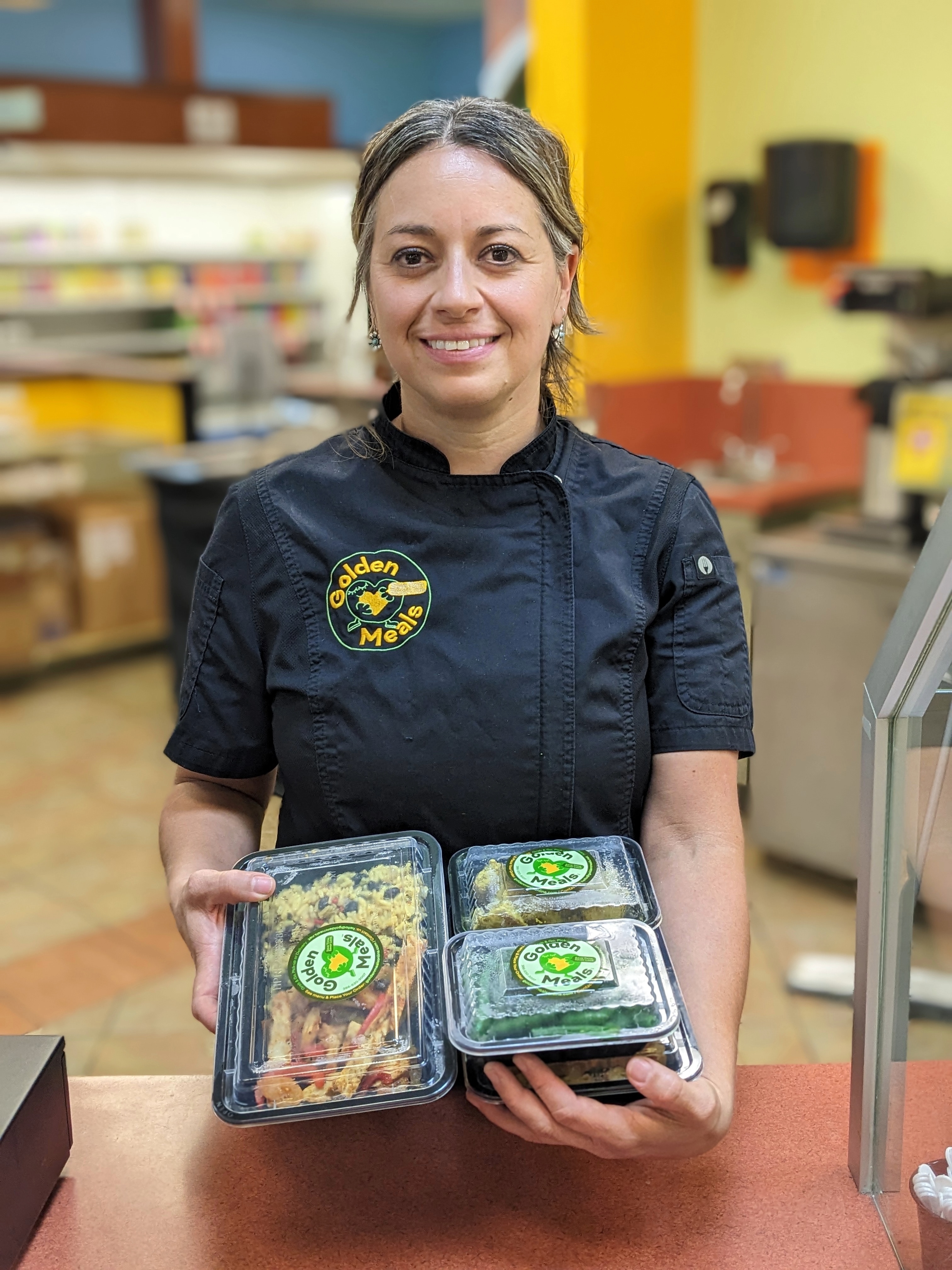
Nora doesn’t shy away from talking about the hurdles. “The recession in 2008 hit us hard,” she remembers. “We had to get creative - package deals, specials, anything to bring people in.” Then came the hurricanes, five in their first year in Florida. And of course, COVID lockdown.
“That was one of the toughest. We had no staff. It was just me, my brother, my nephew, my niece. We were cooking, cleaning, delivering — everything. But we made it. That’s what matters.”
For other small business owners, she offers a simple but powerful reminder: “You just keep going. You pivot, you adapt, you lean on your family and your community. And you never lose sight of why you started.”
📍 Located inside the Natural Market
🕚 Open Monday–Friday, 11 AM to 3 PM
📱 Order online or through the Golden Meals app
🚚 Free delivery available for local orders
Whether you're a parent looking for healthier alternatives, a student in need of quick fuel, or a senior seeking convenient meals that actually taste good — Golden Meals has something on the menu for you.

At East Coast Precision, a mid-sized manufacturing company in Florida, business was booming. Their team of 75 employees worked hard producing high-quality aerospace components, and their reputation for precision and reliability was unmatched. But as the company grew, its leadership team—Mark, the founder, and Sarah, the operations manager—realized their employee benefits needed a rethink.
The question wasn’t just about what benefits to offer, but why.
East Coast Precision had a unique culture. Their employees valued stability, but they also needed flexibility. Many had families, some were nearing retirement, and a few had been with the company since its early days. Their competitor across town shut down for two weeks every December, giving employees a built-in break. But Mark and Sarah knew that wouldn’t work for them—their production schedule relied on steady output, and some employees preferred to spread their vacation days throughout the year.
Then came the tougher decisions: PTO policies, sick days, and financial benefits. Some employees wanted a 401(k), but others, like newer hires fresh out of trade school, were more concerned about weekly take-home pay than long-term savings. The leadership team had to balance what was best for employees with what kept the business strong.
In the end, they set clear, fair policies:
The result? Employees felt valued, turnover dropped, and the company’s production remained steady.
This lesson applies beyond manufacturing. Whether you run a law firm, a retail store, or a tech startup, the benefits you offer should reflect your company’s values and mission.
For a deeper dive into how company culture and leadership impact employee benefits, check out this episode of The Expandable video series:
▶️ watch here
This video highlights the importance of strong leadership in shaping workplace culture, ensuring that employees are supported while keeping the organization’s mission at the forefront. The same principles apply when designing benefits—leaders must make choices that align with their company’s values while balancing business needs.
Ultimately, employee benefits should be a reflection of your company’s identity. They should serve your employees while keeping the business strong and able to serve its customers. Whether that means closing for two weeks each year or offering flexible PTO, the key is to make intentional choices—ones that align with your mission and show employees that they matter.
At Surety Bank, we understand that businesses thrive when they build strong relationships—both with their customers and their teams. When you design benefits that truly fit your company culture, you create a workplace where employees feel valued, engaged, and ready to do their best work.
In the Summer 2025 issue of Building Central Florida Magazine, Surety Bank’s CEO Ryan James maps out a playbook for contractors battling the tariff-driven spikes in steel, aluminum, and other construction staples. James urges firms to replace one-job-at-a-time budgeting with rolling, company-wide cash-flow forecasts; to negotiate for delivery and payment flexibility; to lock in contingency capital before trouble hits; and to embed escalation clauses that keep margins intact—all while maintaining proactive, transparent communication with clients.
Read the full article on page 17:
Building Through the Turbulence – Building Central Florida Magazine
It’s easy to assume that in a digital world, check fraud is a thing of the past. But the reality is quite the opposite. In 2023 alone, check fraud losses in the Americas totaled a staggering $21 billion—representing 80% of all global check fraud cases. Despite a steady decline in the use of checks, fraudsters are doubling down on a still-vulnerable payment channel.
So what happens when a check your business issued ends up in the wrong hands?
Let’s say you wrote a vendor check back in February. Today, that check suddenly clears—but it’s been altered or stolen. What’s your next move? Do you catch it in time? Will your bank reimburse the loss? If you’re like many business owners, you’d expect your bank to take care of it. But depending on the terms in your bank’s Deposit Agreement, you may only have 30 days from the date of your statement to report the fraud and recover those funds. And once that window closes, so may your chances of getting that money back.
At Surety Bank, we want our business clients to know that help exists—and it's called Positive Pay.
Positive Pay is a fraud prevention tool that verifies checks presented for payment against a list of checks you’ve actually issued. If the details don’t match, the bank flags the check and reaches out before funds are released.
It’s like having a security checkpoint for every check your business issues.
Here’s what fraud can really cost your business:
Surety Bank’s Positive Pay solution is designed to reduce those risks before they become losses. Instead of waiting for fraud to strike, it gives business owners a chance to act first.
Most business owners don’t have the luxury of watching every check line item on their bank statement. Positive Pay works in the background—quietly checking, flagging, and helping you intercept fraud before it’s too late.
By offering this service, we’re not just protecting your account—we’re protecting your time, your reputation, and your peace of mind.
Check fraud isn’t going away. But your exposure to it can.
If you’re still issuing paper checks, it’s time to ask yourself: How am I protecting my business from check fraud? At Surety Bank, we’re ready to help you find the answer.
Reach out to our Treasury Management team to learn how Positive Pay can fit into your fraud prevention strategy.
Paper checks may feel old-school, yet they remain the easiest gateway for thieves. The U.S. Treasury reports that check-fraud suspicious-activity filings have climbed 385 percent since the pandemic, while 63 percent of companies faced attempted or actual check fraud in 2024, according to the Association for Financial Professionals’ 2025 survey.occ.govafponline.org Those numbers tell a blunt story: even as businesses adopt ACH and virtual cards, the humble check still opens a back door to five- and six-figure losses.
The phone lit up in the back office of Sunshine Custom Cabinets on a Thursday afternoon.
Co-owner Angela Moreno glanced at the caller ID from her bank and expected a routine wire inquiry. Instead she heard:
“Ms. Moreno, six checks just cleared your account for almost ten thousand dollars each. Can you confirm them?”
Angela had mailed only three checks that week, none over $4,500. Somewhere between the post-office drop box and her suppliers’ lockboxes, thieves had “washed” the envelopes, bleached the ink, and rewritten the checks for a cool $59,821.32—wiping out two payroll cycles in minutes.
The next 48 hours blurred into police reports, fraud affidavits, and tense conversations with employees wondering if Friday’s pay would arrive. The bank eventually credited most of the money, but cash flow froze for nearly a month, and the team sank forty billable hours into cleaning up—a cost no insurance policy reimbursed.
Check fraud has morphed from fax-era nuisance to organized, AI-enhanced side hustle. The good news: consistent, unglamorous discipline—secure mailing, rapid reconciliation, and an automated pre-clearance layer—sends fraudsters looking for softer targets. Angela calls that Thursday “the most expensive lesson I never budgeted for.” Tighten your routine today, and you won’t need the same wake-up call.
Need a practical walkthrough of daily controls—minus the jargon? Talk with our Treasury Management team about fitting these layers to your workflow before your next envelope hits the mail.
As more banking moves online, security has become just as important as convenience. Whether you’re checking a personal account or managing company finances, your computer habits play a critical role in keeping your information safe. A few consistent practices can greatly reduce your risk of fraud and protect sensitive data.
Malware can capture keystrokes, steal login credentials, and access personal files without you realizing it. To stay protected:
Make full use of the security tools your devices and bank provide:
Closing your browser window isn’t enough to end your session.
Browsers can store sensitive information like login pages or cached credentials. To protect yourself:
Phishing emails and fraudulent pop-ups can trick you into giving away banking information. Watch for:
Best practice: Always access your bank by typing the official web address directly into your browser, never through email or ad links.
Businesses face higher risks, so proactive steps are essential:
Online banking can be safe and reliable when paired with good cybersecurity habits. By:
…you can protect both your finances and your peace of mind.
The key is consistency. Security isn’t a one-time task—it’s a set of habits built into your everyday banking routine. Taking these steps ensures your accounts remain secure, your sensitive information stays private, and you can manage your finances confidently, whether personally or for your business.
In the heart of downtown, amidst the vibrant pulse of local eateries and community events, there’s a name that keeps coming up: Chef Nora. If you’ve dined at De La Vega, you’ve likely experienced her artistry on a plate. But beyond the signature flavors and culinary finesse, there's a deeper, richer story — one of family, perseverance, and community love. And now, with her latest venture, Golden Meals, Chef Nora is cooking up something even more personal.
Chef Nora’s journey into the restaurant world began two decades ago when she and her family — her parents, brother, and sister — moved from New Mexico to Florida. They left behind everything familiar on the word of a family friend who saw promise in a vacant restaurant spot downtown.
With only a bit of restaurant experience between them, they leapt into entrepreneurship. “It wasn’t just a job,” Nora recalls. “I had already worked in restaurants. I realized what I really wanted was to have my own.” The family rallied around her dream — a move that not only shaped their livelihoods but also laid the groundwork for something bigger than any one of them could have imagined.
Their first venture was De La Vega — a name that not only carried their family heritage but symbolized their growing identity in the community. “We started with Tex-Mex,” Nora explained, “but quickly realized there were too many of those already. So we pivoted to something unique: Latin fusion with a tapas concept.”
It was a family effort from the start. Nora spearheaded the menu, crafting recipes with creativity and care, while her brother took on the general manager role. “It was our school,” she says. “Everything we’ve learned in the past 20 years, we learned by doing.”
Today, De La Vega is more than a restaurant — it’s a beloved local fixture. With loyal customers, an ever-evolving menu, and a consistent focus on flavor, it’s the kind of place that gets recommended again and again.
The concept for Golden Meals was born not in a commercial kitchen, but in Nora’s own home. “My dad was living in the senior apartments, and I used to make meals for him — healthy, ready to eat, so he didn’t have to cook.” After he passed away three years ago, Nora found herself talking to his neighbors — many of whom had similar needs. The idea began to take shape: a meal service designed to support seniors, promote wellness, and most importantly, taste amazing.
But what started as a personal project in memory of her father has grown into something with far wider impact.
While initially conceived as a service for seniors, Golden Meals quickly found a broader audience. “Everyone needs healthy food — busy moms, students, professionals,” Nora notes. “We realized this wasn’t just about one group. It’s for anyone who wants quick, affordable, and nutritious meals.”
When a deli inside a local natural market became available, the opportunity felt serendipitous. “Everything was ready — the kitchen, the space. We just had to bring the concept and the heart.”
Golden Meals officially opened its doors four months ago, operating weekdays from 11 a.m. to 3 p.m. It functions as both a grab-and-go cafe and a meal delivery service, offering flexible access for people with packed schedules or limited mobility. And yes — delivery is currently free.
Unlike De La Vega’s Latin fusion focus, Golden Meals is all about clean, fresh ingredients and variety. “We’re not tied to any one cuisine here. We can offer pasta, Asian dishes, vegan options — whatever inspires us and serves our community.”
Everything is made in-house, from scratch. Think: vibrant green beans sautéed with garlic and olive oil, sweet potatoes roasted to perfection, and macaroni salad that’s light but packed with flavor. Sodium and sugar are kept low; flavor is boosted with herbs and spices, not additives.
“We don’t want ‘healthy’ to mean boring,” Nora laughs. “You can eat well and still love every bite.”
Why the name Golden Meals? It’s a tribute to Nora’s father and the community he was part of. “It started with the idea of serving those in their golden years,” she says. “But now it means meals that are golden in quality, golden in purpose. Meals that make you feel good.”
Nora doesn’t shy away from talking about the hurdles. “The recession in 2008 hit us hard,” she remembers. “We had to get creative - package deals, specials, anything to bring people in.” Then came the hurricanes, five in their first year in Florida. And of course, COVID lockdown.
“That was one of the toughest. We had no staff. It was just me, my brother, my nephew, my niece. We were cooking, cleaning, delivering — everything. But we made it. That’s what matters.”
For other small business owners, she offers a simple but powerful reminder: “You just keep going. You pivot, you adapt, you lean on your family and your community. And you never lose sight of why you started.”
📍 Located inside the Natural Market
🕚 Open Monday–Friday, 11 AM to 3 PM
📱 Order online or through the Golden Meals app
🚚 Free delivery available for local orders
Whether you're a parent looking for healthier alternatives, a student in need of quick fuel, or a senior seeking convenient meals that actually taste good — Golden Meals has something on the menu for you.
At East Coast Precision, a mid-sized manufacturing company in Florida, business was booming. Their team of 75 employees worked hard producing high-quality aerospace components, and their reputation for precision and reliability was unmatched. But as the company grew, its leadership team—Mark, the founder, and Sarah, the operations manager—realized their employee benefits needed a rethink.
The question wasn’t just about what benefits to offer, but why.
East Coast Precision had a unique culture. Their employees valued stability, but they also needed flexibility. Many had families, some were nearing retirement, and a few had been with the company since its early days. Their competitor across town shut down for two weeks every December, giving employees a built-in break. But Mark and Sarah knew that wouldn’t work for them—their production schedule relied on steady output, and some employees preferred to spread their vacation days throughout the year.
Then came the tougher decisions: PTO policies, sick days, and financial benefits. Some employees wanted a 401(k), but others, like newer hires fresh out of trade school, were more concerned about weekly take-home pay than long-term savings. The leadership team had to balance what was best for employees with what kept the business strong.
In the end, they set clear, fair policies:
The result? Employees felt valued, turnover dropped, and the company’s production remained steady.
This lesson applies beyond manufacturing. Whether you run a law firm, a retail store, or a tech startup, the benefits you offer should reflect your company’s values and mission.
For a deeper dive into how company culture and leadership impact employee benefits, check out this episode of The Expandable video series:
▶️ watch here
This video highlights the importance of strong leadership in shaping workplace culture, ensuring that employees are supported while keeping the organization’s mission at the forefront. The same principles apply when designing benefits—leaders must make choices that align with their company’s values while balancing business needs.
Ultimately, employee benefits should be a reflection of your company’s identity. They should serve your employees while keeping the business strong and able to serve its customers. Whether that means closing for two weeks each year or offering flexible PTO, the key is to make intentional choices—ones that align with your mission and show employees that they matter.
At Surety Bank, we understand that businesses thrive when they build strong relationships—both with their customers and their teams. When you design benefits that truly fit your company culture, you create a workplace where employees feel valued, engaged, and ready to do their best work.
For Dan Glenn, Pastor of Stetson Baptist Church in DeLand, Surety Bank has become much more than the place where the church did its banking. Over the years, the initial banking relationship has grown into a partnership centered around a shared commitment to the community.
That partnership took on new meaning in 2018 when Stetson Baptist Church launched Night to Shine, an unforgettable prom experience for people with special needs held in partnership with the Tim Tebow Foundation.
Creating an experience like Night to Shine requires significant support, and Surety Bank was one of the event's earliest sponsors.
“Surety was one that came on very early saying, ‘Hey, we want to support that. We want to be a part of it.’”
For Dan, that moment marked a shift in the relationship. It became much more personal and community focused.
Surety continued supporting Night to Shine year after year, but one experience in particular showed Dan what that partnership truly meant.
After the first Night to Shine, Dan realized the church had never properly thanked Surety for its sponsorship. When it came time to plan the event again, he felt hesitant approaching Surety for another year of support.
The response surprised him.
There was no hesitation. Surety wanted to be involved again.
Years later, that commitment went even further when Surety reached out to the church without being asked and offered to increase its support.
“They have an intention to be generous, even when generosity may or may not be expected or requested.”
For Dan, that willingness to look for opportunities to make a greater impact is part of what distinguishes Surety Bank as a community organization.
Instead of simply waiting for someone to present a sponsorship request, Surety has been willing to ask a different question: How can we do more?
That philosophy extends beyond a single event.
Dan describes Surety not simply as a community bank, but as a “community-centered organization” that genuinely cares about DeLand and the relationships it has built throughout the city.
That personal connection is something Dan has experienced firsthand. His relationship with Surety isn't limited to the organization itself. It's also built through relationships with the people behind it.
As Surety Bank celebrates 100 years, Dan believes that commitment to people and community helps explain why the bank has remained part of DeLand for generations.
Over the past century, both the bank and the city have grown and changed. Yet Surety has continued to serve the community throughout that growth.
For Dan, that's exactly why Surety's 100th anniversary message, “How we've always done it is how we'll always do it,” resonates.
“The way they've always done things has been people centered, relationships centered, community centered.”
Those values create something that goes beyond banking. They create trust. They allow organizations like Stetson Baptist Church to know what to expect from a partner that has consistently shown up before and intends to continue showing up in the future.
After years of partnership, Dan hopes that part of Surety never changes.
This is how Surety Bank has always done it. It's how we will always do it.
For Austin Scott, starting a business wasn’t the result of a lifelong plan. It was something that grew over time, much like the lawns he now helps his customers care for.
Born and raised in DeLand, Austin is the owner of Coastal Green Pest Solutions, a new Volusia County business specializing in lawn treatments, pest management, fertilization, and the care of palms and shrubs.
The company may be new, but Austin is far from new to the work.
Before entering the lawn and pest control industry, Austin was selling auto parts at O’Reilly Auto Parts. Then a landscaper friend suggested he take a job with a local pest control company.
He gave it a shot and discovered an industry that fascinated him.
“I like that I could learn something new every day,” Austin says. “You get to see different problems, and you get to see the benefits of your own labor making a lawn beautiful. You get to see it go from nothing to something.”
Austin spent nearly six years in the industry, gradually developing an understanding of not only what products to use, but why lawns develop problems in the first place.
Interestingly, the work even gave him a new appreciation for a subject he once struggled with: chemistry.
In school, chemistry had never come naturally to Austin. But working with fertilizers, herbicides, insecticides, fungicides, and nutrients gave those concepts a real-world application.
“You get to learn something and then apply it directly,” he says.
And the more Austin learned, the more he realized there was an opportunity to do things differently.
Austin believes one of the biggest shortcomings in the lawn and pest control industry isn't necessarily the products or treatment programs companies use. It's the communication that happens, or doesn't happen, between the company, technician, and homeowner.
A lawn problem can be the result of insects, fungus, nutrient deficiencies, irrigation issues, environmental stress, or a combination of factors. Simply treating the symptom doesn't always solve the underlying problem.
Austin wants Coastal Green Pest Solutions to be different.
“I take pride in being the solution and the end to the revolving door when it comes to these lawn programs,” he says.
That means spending time with homeowners, explaining what is happening on their property, and helping them understand what needs to change.
Austin compares a lawn or landscape to the human body. One problem can affect the health of the entire system. Killing an insect, for example, may address the immediate issue, but it doesn't necessarily explain why the lawn became susceptible to the pest in the first place.
“If you can be the middleman between the problem, the chemicals, and the customer, and you can explain all that smoothly, that's normally the end,” Austin says. “A lot of people don't take the time to talk to their customers and make sure they understand.”
It's an approach built around education and relationships as much as treatment.
When the company Austin had worked for was sold, he saw an opportunity to take everything he'd learned and build something of his own.
Coastal Green Pest Solutions was born.
Today, Austin primarily works with residential customers throughout Volusia County who care about the long-term health and appearance of their properties.
His services include:
Austin's philosophy isn't about simply “spraying and praying,” as he puts it. Every property is different, so understanding what's actually happening comes before recommending a solution.
That philosophy also shapes how he plans to grow the business.
Starting a company requires more than expertise and ambition. There are trucks, equipment, products, operating expenses, and the reality that revenue doesn't necessarily arrive the moment the business opens its doors.
Austin knew he needed some financial breathing room as he got Coastal Green Pest Solutions off the ground.
That's where Surety Bank came in.
Austin first learned about Surety through his father, who had worked in real estate and developed a relationship with Surety Bank CEO Ryan James over the years.
When Austin was preparing to launch Coastal Green Pest Solutions, that local connection opened the door to a conversation.
“I was just looking for a good little loan—something to get me by, that way I had a little bit of breathing room,” Austin says. “I was very questionable on how I was going to make everything work, and honestly, I'm very grateful for Surety stepping in.”
Surety provided a business loan directly to Coastal Green Pest Solutions, giving Austin additional resources and flexibility during the critical early months of building the company.
For Austin, the experience demonstrated one of the advantages of working with a community bank: relationships matter.
Ryan knew Austin's family. He'd seen Austin working around town. And instead of Austin simply being another application, there was an opportunity to understand the person and business behind it.
That trust helped a local entrepreneur take the next step.
Just a couple of months into the business when we spoke with him, Austin already had big ambitions for Coastal Green Pest Solutions.
Eventually, he'd like to have multiple trucks on the road, a dedicated irrigation team, a sales team, and expanded services including home pest and termite control.
But he's in no hurry to grow simply for the sake of getting bigger.
Austin wants to make sure the service and customer experience that distinguish Coastal Green today remain intact as the company expands.
“If I'm not taking the time to personalize your service and making sure that I'm putting down what I'm promising, then there's no point in me opening up the next step,” he says.
He describes his philosophy simply as “natural growth or no growth.”
It's an especially fitting philosophy for someone who spends his days helping things grow.
For now, Austin is focused on building relationships, earning the trust of homeowners and landscapers throughout Volusia County, and developing Coastal Green one customer at a time.
And he's doing it in the community he has always called home.
“I still enjoy the small-town aspect of DeLand,” Austin says. “Raising a family here, having good friends here, it's very nice. DeLand's a good home base.”
As DeLand and Volusia County continue to grow, Austin hopes Coastal Green Pest Solutions will grow right alongside them, without losing the personal relationships that helped get the business started in the first place.
Coastal Green Pest Solutions serves homeowners throughout Volusia County. For homeowners who care about the health and appearance of their lawn and landscaping, Austin and Coastal Green provide personalized lawn treatment, pest management, fertilization, and plant health solutions.
Personal fraud continues to evolve, and scammers are finding increasingly sophisticated ways to target consumers. From AI-powered messages that appear surprisingly convincing to attempts to gain access to entire financial accounts. Recognizing the warning signs is becoming more important than ever.
While you can't prevent every fraud attempt, knowing what to watch for and taking a few proactive steps can make it much harder for scammers to succeed.
Artificial intelligence is making fraudulent calls and text messages feel more personal and legitimate. Scammers can use AI to create convincing communications designed to make you believe you're interacting with a trusted person or organization.
Be cautious when you receive an unexpected call or message asking for personal information, money, or access to an account. Before responding or taking action, reach out to Surety Bank directly to verify they are the ones calling. This step could mean not being scammed out of your money.
Fraudsters are increasingly looking beyond individual credit card numbers and attempting to gain access to entire financial profiles, including personal bank and investment accounts.
Protect your accounts by regularly reviewing activity for transactions you don't recognize and using multifactor authentication whenever it's available. Never provide your password, login credentials, or verification codes to someone who contacts you unexpectedly.
If you notice something unusual in your Surety Bank account, contact us promptly.
Older adults continue to be frequent targets of financial scams, particularly those involving tech support and investment-related schemes.
These scams often rely on urgency or fear to convince someone to act before they have an opportunity to question what's happening. Talk with older family members about common scams and encourage them to check with someone they trust before sending money or providing sensitive information in response to an unexpected request.
Taking a few minutes to verify a situation can help prevent a significant financial loss.
Protecting yourself doesn't require becoming a fraud expert. Start by being skeptical of unexpected requests for money or information, especially when someone pressures you to act immediately.
Use strong, unique passwords and enable multifactor authentication when available. Avoid clicking links in unexpected emails or text messages, and regularly review your bank accounts and credit reports for activity you don't recognize.
Most importantly, trust your instincts. If something doesn't feel right, stop and verify before taking action.
If you'd like to take additional steps to protect yourself, here are three resources worth exploring:
FTC IdentityTheft.gov
Best for someone who thinks their identity has already been compromised. The FTC provides a personalized recovery plan and steps for addressing identity theft.
Visit IdentityTheft.gov
FTC Credit Freeze & Fraud Alert Guide
Customers can place a free credit freeze, which can prevent identity thieves from opening new credit accounts in their name, or add a fraud alert.
Learn About Credit Freezes & Fraud Alerts
Aura
For those interested in a paid protection service, Aura offers identity and financial monitoring tools and other fraud-protection features. I’d position this as an optional third-party tool, not something Surety is recommending over other services.
Explore Aura
These resources are provided for informational purposes. Surety Bank does not endorse or guarantee any third-party product or service.
Fraud tactics will continue to change, but one of your strongest defenses is also one of the simplest: slow down.
Scammers often depend on creating urgency so you act before thinking. If you're unsure about a request involving your Surety Bank account, don't rely on the phone number, link, or contact information provided in the message. Contact Surety Bank directly through a trusted channel.
We're here to help you protect your financial information and recognize potential fraud before it becomes a loss.
For Maria Bonfiglio, working at Surety Bank has always been about more than banking. It's about taking care of people.
Maria has been part of the Surety Bank family for nine years, but her journey began with a simple text message. A former boss she had stayed in touch with reached out years after they had worked together and told her, "I have the perfect job for you." Maria's response was simple: "Where should I sign?"
Nine years later, her enthusiasm hasn't changed.
"I love it. I love my job."
Over the years, Maria's role has evolved, giving her the opportunity to learn new skills and develop deeper relationships with customers. She has gotten to know some of them so well that she can recognize who is calling just by the sound of their voice. For Maria, those relationships are what make Surety feel less like a workplace and more like a family.
That personal connection also shapes the way Maria approaches protecting customers.
When something doesn't seem right, she isn't afraid to ask questions. Whether she's reviewing a check or helping someone resolve an issue with an account, Maria understands that taking a little extra time can make a significant difference.
"We really care about our customers," Maria explains. Even when customers may wonder why the bank is asking additional questions, she wants them to understand the reason behind it. "We don't want them to lose money."
For Maria, that care isn't limited to customers. She has experienced it personally as an employee.
During some of the most difficult moments of her life, including an extended hospital stay and the loss of her son, Maria remembers her Surety family checking on her, visiting her, and making sure she knew she wasn't alone. Those experiences showed her that the relationships Surety talks about aren't simply something customers experience. They're part of the culture inside the bank, too.
It's also why Maria believes Surety Bank has remained part of the community for 100 years. She has worked at other banks, but says Surety's involvement in the community feels different. The bank isn't trying to be the biggest. Instead, it has remained focused on the people and communities it serves.
That same philosophy comes through in Maria's relationships with her customers. Some have developed such a strong connection with her that when they call, they specifically ask for Maria. She takes pride in being someone they know they can turn to when they have a question or need assistance.
After nine years, Maria still says thank you for the opportunity that brought her to Surety Bank. Her story is a reminder that relationship banking begins with people who genuinely care about the people on the other side of the counter or phone.
This is how Surety Bank has always done it. It's how we will always do it.
For Lewis Long III, banking with Surety Bank is a relationship that has lasted more than five decades.
As one of Surety Bank's longest-standing customers, Lewis has watched the bank grow alongside the community since his connection to Surety began more than 50 years ago. He originally opened a savings account after hearing from neighbors that the bank consistently offered strong value and genuinely cared about its customers.
Over the years, Lewis has seen a lot of change. He remembers making deposits with a passbook while employees manually updated balances using a hand-cranked adding machine. What hasn't changed, however, is the way Surety Bank treats the people who walk through its doors.
For Lewis, that commitment extends beyond his own banking experience. When his sons were born, he opened accounts for each of them at Surety Bank, continuing a family tradition that has now spanned generations. One of his sons even participated in the ribbon-cutting ceremony when Surety Bank dedicated its current building in the early 1990s.
Throughout his life of military service, public service, and community involvement, Lewis has always returned to the same bank.
What has kept him loyal all these years?
The answer is simple: people.
"You couldn't ask for better service or better people," Lewis says. "I don't know how they remember everybody's name that walks in the door, but they do. They're just super folks. The people have always been a gift to us and to the community."
Lewis believes that the values Surety Bank was founded on continue to define the bank today. One story from the bank's early history has always stayed with him. During the Great Depression, he recalls hearing that Surety worked with customers rather than rushing to foreclose on them because they cared more about helping people than taking their property. That philosophy, he says, is still reflected in the way the bank serves its customers today.
It's one of the reasons Lewis has become an advocate for the bank wherever he goes.
Whether he's encouraging friends to open a money market account, sharing the bank's history, or even suggesting a new Surety branch for his hometown of Lake Helen, Lewis proudly recommends the bank he's trusted for more than half a century.
"I wouldn't champion the bank if I didn't believe in these folks and believe in this bank," he says. "Everybody is important. They see past whatever's bothering someone that day and still treat people with kindness and respect."
As Surety Bank celebrates 100 years of serving Central Florida, customers like Lewis remind us that while banking has evolved, some things should never change. Genuine relationships, exceptional service, and a commitment to the community remain at the heart of everything we do.
This is how Surety Bank has always done it. It's how we will always do it.
For 100 years, Surety Bank has believed that community banking means more than serving customers inside the walls of a branch. It means investing in the people, organizations, and partnerships that help our communities thrive.
That commitment is something Carla Quann, Director of Community Relations for the Volusia Sheriff's Office, has experienced firsthand.
"Our goal is to support everyone in our community," Carla explains. "Ryan [James] wanted to be a part of what we're doing because he cares about the community."
The partnership between Surety Bank and the Volusia Sheriff's Office began when Surety Bank President & CEO Ryan James joined the Volusia Sheriff's Foundation Board. Since then, the relationship has grown into a collaborative effort focused on addressing some of the community's greatest needs.
One example came during the holiday season, when thousands of local families faced uncertainty after SNAP benefits were unexpectedly interrupted. Through the combined efforts of businesses, volunteers, and community organizations, more than 3,500 grocery bags were distributed to families throughout Volusia County.
According to Carla, Surety Bank was an important part of making that effort possible.
Beyond community events and charitable initiatives, the partnership has also helped strengthen public safety.
As financial scams targeting older adults became increasingly common, Surety Bank worked alongside the Sheriff's Office to provide education, share industry expertise, and help detectives better recognize the warning signs of fraud.
That collaboration ultimately helped lead to the creation of the Volusia Sheriff's Office Financial Crimes Unit—a dedicated team focused on protecting residents from fraud and financial exploitation.
Working together, those efforts have helped recover more than $2 million for local victims of financial crimes.
For Carla, those results reflect what makes Surety Bank different.
"They're not just another hometown bank," she says. "They care about their community."
She believes that commitment starts with customer service but extends far beyond banking. Whether supporting nonprofit organizations, helping law enforcement address emerging scams, or simply answering the phone when someone needs help, Surety Bank has built relationships rooted in trust.
"People trust them," Carla says. "They've built that trust with their customers, and that's why people stay."
As Surety Bank celebrates a century of serving Central Florida, partnerships like this demonstrate that community banking isn't defined only by financial services—it's measured by the impact a bank has on the people and communities it serves.
For 100 years, Surety Bank has believed that when communities succeed, everyone succeeds. Through partnerships built on trust, service, and shared purpose, that commitment continues today—and will continue for generations to come.
Community
Personal Banking, Online Banking


Surety Bank continually works to provide greater accessibility to all of its products and services. If you have any questions about accessible banking, call us at 386-734-1647
© 2026 Surety Bank